
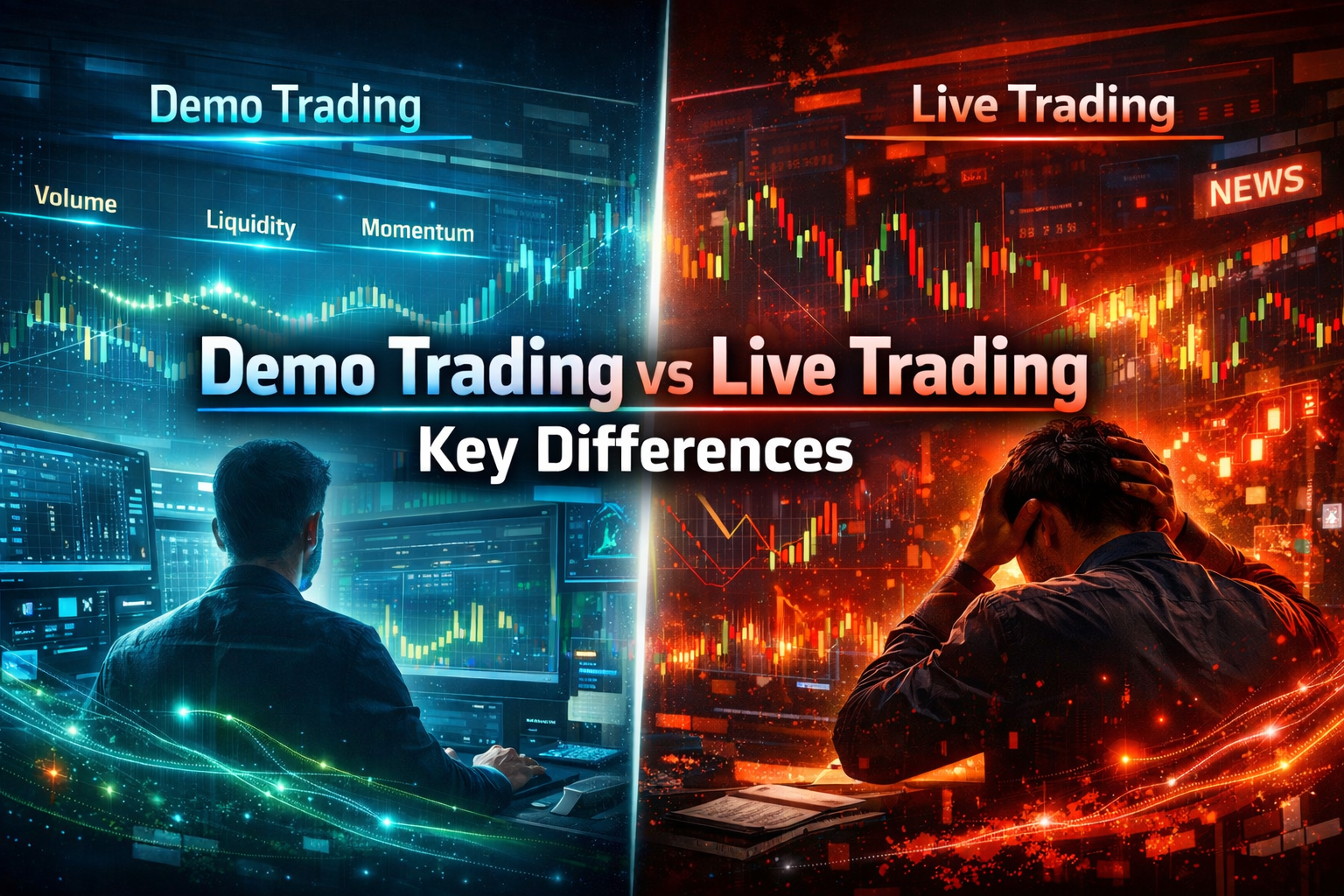
1. Introduction: Understanding Market Traffic Before Real Money
Before stepping into live trading, every trader first interacts with the market in a controlled environment called demo trading. But to truly understand what is happening behind price movements, you need to think in terms of a deeper framework:
TrafficDomination Concept (Core Philosophy)
At https://trafficdomination.net/, trading is not just buying and selling—it is a flow system:
- Traffic = Market Volume, Liquidity, Momentum
This represents how money moves in the market:- Volume shows participation (how many traders are active)
- Liquidity shows how easily price moves without resistance
- Momentum shows the speed and direction of price movement
When all three combine, you are not just watching charts—you are reading market traffic behavior.
- Domination = Strategy, Control, Profit Optimization
This is where real trading success happens:- Strategy gives direction
- Control manages emotions and risk
- Profit optimization ensures consistent growth
In simple words:
👉 Traffic tells you what the market is doing
👉 Domination tells you how you win from it
Why Beginners Start with Demo Trading
Most traders begin with a demo account because it offers a risk-free environment. It allows them to:
- Learn how charts move
- Practice entries and exits
- Test strategies without losing real money
- Understand basic market structure
On the surface, demo trading feels like the perfect training ground. There is no fear, no financial pressure, and no emotional burden.
But this is exactly where the illusion begins.
The Core Problem Most Traders Face
Here is the harsh reality of trading psychology:
Most traders succeed in demo trading but fail in live markets.
Why does this happen?
Because demo trading removes the most important element of trading:
- Emotional pressure
- Real risk exposure
- Psychological discipline
In demo, traders behave like strategists.
In live markets, they behave like emotional participants.
This is where the gap between knowledge and execution appears.
The Hook Problem: Why Strategy Breaks in Real Trading
Many beginners ask:
“Why does my strategy work in demo but fail in real trading?”
The answer is simple but powerful:
- In demo trading, you are analyzing fake pressure
- In live trading, you are facing real market traffic
When real money is involved:
- Fear enters decision-making
- Greed influences exits
- Hesitation destroys timing
This is not a strategy problem—it is a trading psychology difference problem.
2. What is Demo Trading? (Simulation of Market Traffic)
Demo trading is the first real step most beginners take into the financial markets. It is a practice environment that simulates real trading conditions, but without using actual money. Think of it as a training ground where you can learn how the market behaves without the fear of losing capital.
From the TrafficDomination perspective (https://trafficdomination.net/), demo trading is where you start observing market traffic—but you are not yet operating in real conditions of domination.
Definition: Practice Trading with Virtual Money
Demo trading is a simulated trading setup provided by brokers where:
- You trade using virtual funds
- Market prices behave similarly to real markets
- You can open and close positions just like live trading
- No real profit or loss occurs
In simple terms:
👉 It is a risk-free mirror of the real market
It is designed to help beginners learn how trading platforms work before risking actual capital.
Key Features of Demo Trading
1. No Financial Risk
The biggest advantage of demo trading is that:
- You cannot lose real money
- You can experiment freely
- You can make mistakes without consequences
This creates a safe environment, but also removes emotional pressure.
2. Simulated Market Conditions
Demo accounts replicate:
- Live price charts
- Market movements
- Order execution process
However, in many cases:
- Execution is smoother than real markets
- Slippage and liquidity issues are reduced or absent
This makes trading feel easier than it actually is in real conditions.
3. Ideal for Beginners
Demo trading is especially useful for:
- Absolute beginners in trading
- People learning platform tools
- Traders testing new strategies
It acts as a learning bridge between theory and real trading execution.
Purpose of Demo Trading
1. Learn Strategy
Demo trading allows you to:
- Test different trading strategies
- Understand entry and exit rules
- Identify what works and what doesn’t
This is where traders build their initial system thinking.
2. Understand Charts (Market Traffic Reading)
You begin to observe:
- Price movements
- Trend direction
- Support and resistance levels
- Volume behavior (conceptually)
From a TrafficDomination view:
👉 You are learning how market traffic flows (volume, liquidity, momentum)
3. Build Trading Habits
Demo trading helps you develop:
- Routine chart analysis
- Discipline in executing trades
- Familiarity with trading platforms
These habits are important before entering real markets, where consistency matters more than excitement.
3. What is Live Trading? (Real Market Domination)
Live trading is the point where everything changes. Unlike demo trading, where outcomes are theoretical, live trading is where real money, real emotions, and real consequences come into play. This is the stage where traders either evolve into consistent performers or exit the market entirely.
From the TrafficDomination perspective (https://trafficdomination.net/), live trading is not just about entering and exiting positions—it is about transforming market traffic (volume, liquidity, momentum) into controlled domination (strategy, discipline, profit optimization).
Definition: Trading with Real Capital in Real Markets
Live trading means:
- Using your own money to trade financial markets
- Executing trades in real-time market conditions
- Experiencing actual profit and loss outcomes
Every trade you take has a direct impact on your financial account. There is no simulation, no reset button, and no second chance on the same opportunity.
In simple terms:
👉 Live trading is real exposure to market reality
Key Features of Live Trading
1. Real Profit & Loss
In live markets:
- Every winning trade increases your capital
- Every losing trade decreases your capital
This creates a powerful feedback loop:
- Success feels rewarding but can lead to overconfidence
- Loss feels painful and can lead to emotional mistakes
Unlike demo trading, every decision carries weight.
2. Real Execution Conditions
Live trading introduces real market behavior such as:
- Slippage (execution at different prices)
- Spread changes (cost variations)
- Liquidity fluctuations
- Volatility spikes during news events
This means:
👉 The market does not always give you the exact price you expect
You are now trading inside real market traffic conditions, not a simulated environment.
3. Emotional Pressure (The Game Changer)
This is the biggest difference between demo and live trading.
In live trading, you experience:
- Fear of losing money
- Greed when profits increase
- Anxiety during volatile moves
- Hesitation before entering trades
These emotions directly influence decision-making. Even the best strategy can fail if emotions are not controlled.
Core Reality of Live Trading
The most important truth in live trading is:
Every decision has financial consequences.
There is no “practice mode” anymore. Every:
- Entry
- Exit
- Stop-loss
- Risk decision
directly affects your capital.
This reality forces traders to:
- Think more carefully
- Manage risk properly
- Control emotions under pressure
4. Core Difference #1: Emotional Pressure (Psychology Gap)
One of the most powerful and often underestimated differences between demo trading and live trading is emotional pressure. This is where most traders experience their first real shock—because the market stops being just numbers on a screen and starts becoming a reflection of their psychological state.
From the TrafficDomination perspective (https://trafficdomination.net/), this is the exact point where market traffic (volume, liquidity, momentum) stops being the main challenge, and internal control (strategy, discipline, emotional stability) becomes the real battlefield.
Demo Trading: No Fear, No Stress
In demo trading, the emotional environment is completely artificial:
- There is no fear of losing money
- There is no stress during market fluctuations
- There is no emotional attachment to trades
Because of this, traders behave differently:
- They enter trades confidently
- They hold positions without hesitation
- They take risks more freely
- They often overtrade without consequences
In this environment, decisions are based purely on logic and strategy. It feels easy because nothing is truly at stake.
But this creates a hidden illusion:
👉 You are learning the market without learning yourself
Live Trading: Fear, Greed, and Hesitation
When traders move into live markets, everything changes instantly.
Now every trade carries real consequences, and emotions become part of every decision:
- Fear appears when price moves against you
- Greed appears when profit starts increasing
- Hesitation appears before entering or exiting trades
Even a simple decision like “Should I close this trade?” becomes emotionally complex.
This emotional shift affects:
- Entry timing
- Exit discipline
- Risk management consistency
- Strategy execution
In live trading, the biggest challenge is no longer the market—it is your reaction to the market.
Reality: Psychology is the #1 Reason Traders Fail
Technical knowledge is important, but it is not the main reason traders lose money.
The real issue is psychological:
- Traders abandon strategies under pressure
- They move stop-losses out of fear
- They exit winning trades too early due to anxiety
- They overtrade after losses to recover quickly
This emotional instability leads to inconsistent performance, even with a good strategy.
In simple terms:
👉 Most traders don’t fail because of the market
👉 They fail because of their mind under pressure
📊 Fact: Emotional Reactions Only Exist in Real Money Trading
One of the most critical realities in trading psychology is:
Real money triggers emotional reactions like fear and regret, which do not exist in demo trading.
Why?
Because in demo trading:
- Loss is just a number
- Profit is just a simulation
- There is no real consequence
But in live trading:
- Every loss feels personal
- Every profit feels emotional
- Every decision carries psychological weight
This is why traders often feel “confident” in demo but “uncertain” in live markets.
👉 TrafficDomination Angle: Emotion = Loss of Control = No Domination
In the TrafficDomination system:
- Traffic = Market movement (volume, liquidity, momentum)
- Domination = Strategy + Control + Profit Optimization
But emotion directly disrupts this system.
When emotions take over:
- Strategy breaks down
- Risk becomes inconsistent
- Decisions become reactive instead of planned
So the equation becomes:
Emotion = Loss of Control = No Domination
Because without control:
- You cannot execute strategy properly
- You cannot manage risk effectively
- You cannot achieve consistent profitability
5. Core Difference #2: Risk & Capital Exposure
One of the most dangerous misunderstandings in trading begins with how risk is perceived in demo vs live environments. At first glance, both seem similar—you place trades, set stop-losses, and watch price movements. But the reality underneath is completely different.
From the TrafficDomination framework (https://trafficdomination.net/), this difference defines whether a trader stays in the learning phase of market traffic (volume, liquidity, momentum) or moves into real domination (strategy, control, profit optimization).
Demo Trading: Zero Risk Environment
In demo trading, risk does not truly exist in a meaningful way.
- There is no financial loss
- Capital is virtual and unlimited
- Emotional consequences of losing are absent
Because of this, traders behave very differently:
- They take oversized positions without fear
- They experiment aggressively with lot sizes
- They ignore proper risk rules
- They often chase trades without discipline
This creates a false sense of confidence because:
👉 You can “recover” instantly with no real consequence
So instead of learning disciplined trading, many traders actually learn irresponsible risk behavior in demo accounts.
Live Trading: Real Capital at Risk
Live trading introduces the most critical element of the entire trading process: real financial exposure.
Now every trade affects:
- Your actual account balance
- Your financial stability
- Your emotional state
In live markets:
- A losing trade is no longer theoretical
- A mistake costs real money
- Recovery is not instant or guaranteed
This changes everything about decision-making. Traders must now think in terms of survival, not experimentation.
Strict Risk Management Becomes Mandatory
In live trading, success depends heavily on structured risk control systems.
Traders must implement:
- Fixed risk per trade (percentage-based)
- Stop-loss discipline
- Position sizing strategies
- Capital preservation rules
This is where risk management trading becomes the foundation of survival.
Without it:
- One bad trade can damage your account
- Emotional decisions become more frequent
- Long-term consistency becomes impossible
So live trading forces discipline in a way demo trading never does.
📊 Insight: Why Demo Traders Take Bigger Risks
A key behavioral pattern in trading psychology is:
Traders take significantly bigger risks in demo trading because there are no consequences.
Why does this happen?
Because:
- Loss is not felt emotionally
- Capital is not real
- There is no fear of failure
As a result:
- Traders increase lot sizes unrealistically
- They overtrade frequently
- They ignore proper risk-to-reward ratios
But when they switch to live trading, these same habits become dangerous because real money changes everything.
6. Core Difference #3: Execution & Market Reality
One of the most eye-opening differences between demo trading and live trading is how orders are executed in the market. Many beginners assume that if a strategy works in demo, it will behave the same way in live trading—but execution reality proves otherwise.
From the TrafficDomination perspective (https://trafficdomination.net/), this is where traders directly face real market traffic behavior (volume, liquidity, momentum) instead of a controlled simulation. And this difference can completely change trading results.
Demo Trading: Instant Execution Environment
In demo trading, order execution is designed to be smooth and ideal:
- Trades are executed instantly
- Orders are filled at the exact requested price
- There is no delay or rejection
- Market conditions are simplified
This creates a perfect environment where:
- Entries are always clean
- Exits are always precise
- Strategies appear highly accurate
But this perfection is artificial. It removes real-world friction from trading, which makes performance look more stable than it actually is.
Live Trading: Slippage, Spreads, and Reality
In live markets, execution becomes unpredictable because you are now interacting with real liquidity and real participants.
1. Slippage
Slippage occurs when:
- Your order is executed at a different price than expected
This usually happens during:
- High volatility
- Fast market movements
- News events
Even a small delay can change your entry or exit point significantly.
2. Spread Changes
In live trading:
- The difference between buy and sell prices (spread) is not fixed
- It expands and contracts based on market conditions
During low liquidity or high volatility:
- Trading costs increase
- Entry precision decreases
3. Liquidity Issues
Liquidity refers to how easily a trade can be executed in the market.
In real conditions:
- Large orders may not fill instantly
- Price may move before your order is completed
- Market depth affects execution quality
This means your strategy is not just about prediction—it also depends on how the market accepts your trade.
📊 Fact: Real Market Conditions Change Everything
A critical truth in live trading is:
Live trading is affected by real market conditions like slippage, spreads, and liquidity.
This is why two traders using the same strategy can get completely different results. Execution quality becomes just as important as analysis.
👉 Traffic Concept: Real Market Traffic = Unpredictable Flow
From the TrafficDomination framework:
- Traffic = Market volume, liquidity, momentum
- This traffic is not stable—it is constantly changing
So in live trading:
- Orders are not executed in isolation
- They are executed inside a flowing system of active participants
That means:
Real market traffic = unpredictable flow
Prices move based on:
- Buy and sell pressure
- Liquidity availability
- Momentum shifts
- Institutional activity
This is why live trading feels different—it is not controlled, it is dynamic.
7. Core Difference #4: Strategy vs Discipline
One of the most important lessons in trading is that having a good strategy is not enough. Many beginners assume that once they find a profitable system in demo trading, success is guaranteed in live markets. But reality proves otherwise.
From the TrafficDomination perspective (https://trafficdomination.net/), this is the stage where traders shift from simply understanding market traffic (volume, liquidity, momentum) to building true domination (strategy, control, profit optimization) through discipline.
Demo Trading: Strategy Testing Phase
In demo trading, the main focus is on testing and developing strategies.
Traders typically:
- Experiment with indicators and setups
- Try different entry and exit rules
- Analyze chart patterns freely
- Adjust systems without fear of loss
This environment is useful because it allows traders to:
- Learn how strategies behave in different market conditions
- Understand basic market structure
- Build confidence in technical analysis
However, in demo trading:
👉 Strategy is the only focus
👉 Discipline is not truly tested
Because there is no emotional pressure or real risk, traders often ignore strict rules and still feel successful.
Live Trading: Strategy + Discipline Required
When transitioning to live trading, everything changes.
Now it is not just about having a strategy—it is about executing it consistently under pressure.
Live trading requires:
- Following entry rules without hesitation
- Respecting stop-loss levels every time
- Avoiding emotional decisions
- Sticking to position sizing rules
- Not overtrading after wins or losses
This is where discipline becomes more important than strategy itself.
Even a profitable strategy can fail if:
- Rules are not followed
- Emotions interfere with decisions
- Risk management is ignored
👉 Key Truth: Strategy Works in Demo, Discipline Wins in Live
This is one of the most critical realities in trading psychology:
Strategy works in demo trading, but discipline decides success in live trading.
Why?
Because:
- Demo trading rewards logic without pressure
- Live trading tests behavior under real consequences
So while strategy tells you what to do, discipline ensures you actually do it every single time.
Without discipline:
- Good strategies become inconsistent
- Small losses turn into big ones
- Emotional trading takes control
8. Core Difference #5: Market Conditions & Real-Time Behavior
One of the most underestimated differences between demo trading and live trading is how the market actually behaves in real time. Many traders believe charts move the same way in both environments, but in reality, market conditions in live trading are far more complex, fast, and unpredictable.
From the TrafficDomination perspective (https://trafficdomination.net/), this is where traders face true market traffic reality (volume, liquidity, momentum) without any simplification. It is the stage where theoretical understanding meets real-world chaos.
Demo Trading: Delayed or Simplified Market Data
In demo trading environments, the market is often:
- Slightly delayed or smoothed
- Less reactive to sudden spikes
- Simplified for easier learning
- Missing some real-world complexities
Because of this, price action may look:
- Cleaner
- More predictable
- Less volatile
This creates a learning environment, but not a realistic one. Traders often assume markets behave in a stable and structured way, which is not always true in live conditions.
Live Trading: Real-Time Volatility & True Market Behavior
In live trading, the market is alive and constantly reacting to global events.
You experience:
1. Real-Time Volatility
- Prices move rapidly within seconds
- Sudden spikes and reversals occur
- Market direction can change without warning
This is where understanding market volatility becomes critical, because price behavior is no longer smooth—it is dynamic and aggressive.
2. News Impact
Live markets react instantly to:
- Economic announcements
- Central bank decisions
- Geopolitical events
- Major financial news
These events can:
- Increase volatility instantly
- Break technical patterns
- Create unexpected liquidity shifts
Even strong strategies can fail temporarily during high-impact news.
3. Market Manipulation & Institutional Behavior
In real trading environments:
- Large institutions influence price movement
- Stop-loss hunting can occur
- Liquidity is targeted before major moves
This creates an environment where:
- Price does not always move logically
- Technical analysis alone is not enough
- Timing becomes extremely important
📊 Fact: Demo Markets Don’t Fully Reflect Real Volatility
A key truth every trader eventually realizes is:
Demo environments may not fully reflect real-time market volatility.
This means:
- Signals may appear cleaner in demo
- Trades may execute more perfectly
- Market reactions may feel slower or smoother
But in live markets:
- Everything happens faster
- Liquidity changes instantly
- Price behavior becomes unpredictable
This gap is one of the main reasons traders struggle when switching from demo to live accounts.
👉 Keywords Focus
This section is strongly aligned with:
- market volatility
- liquidity trading
These two concepts define how real markets actually function under pressure.
TrafficDomination Angle: Real Market Traffic = Uncontrolled Flow
In the TrafficDomination system:
- Traffic = Market volume, liquidity, momentum
- In demo trading, this traffic is simplified
- In live trading, this traffic becomes raw and unpredictable
So the reality is:
Real market traffic is not smooth—it is constantly shifting, reacting, and evolving.
This means:
- Liquidity can disappear suddenly
- Momentum can accelerate instantly
- Volatility can spike without warning
And traders must adapt in real time, not rely on ideal conditions.
9. Transition Strategy: From Demo to Live (Traffic → Domination Blueprint)
This is the most critical phase in a trader’s journey. Many traders get stuck in demo trading or fail immediately after switching to live trading because they treat the transition as a simple upgrade. In reality, it is a complete shift from simulation to real market survival.
From the TrafficDomination perspective (https://trafficdomination.net/), this transition is where you move from understanding market traffic (volume, liquidity, momentum) to applying real domination (strategy, control, profit optimization) under pressure.
This is Where Your Brand Philosophy Comes Alive
The real difference becomes clear here:
- Traffic = Learning how the market moves
- Domination = Learning how to control your performance inside that movement
Demo trading builds awareness of traffic.
Live trading tests whether you can dominate it.
This transition is not about speed—it is about structure, discipline, and emotional control.
Step-by-Step Transition Strategy
1. Achieve Consistency in Demo Trading
Before moving to live trading, you must prove consistency in a demo environment.
This means:
- Following a clear strategy
- Maintaining stable win/loss ratios
- Avoiding emotional overtrading
- Respecting risk rules
Consistency is more important than profit here. If you cannot stay consistent in demo, live trading will expose those weaknesses even faster.
2. Start with Small Capital
When moving to live trading:
- Begin with the smallest possible amount
- Treat it as a learning phase, not income generation
This helps you:
- Reduce emotional pressure
- Focus on execution quality
- Learn real market behavior safely
Small capital is your bridge between simulation and reality.
3. Follow Strict Risk Management (1–2%)
Risk control becomes your survival tool.
Best practice:
- Risk only 1–2% per trade
- Avoid over-leveraging
- Use fixed stop-loss rules
This ensures that:
- One loss does not damage your account
- You stay in the market long enough to learn
- Emotional pressure stays manageable
Without risk management, even a good strategy fails in live conditions.
4. Control Emotions
This is the hardest but most important step.
In live trading, you must manage:
- Fear after losses
- Greed after wins
- Hesitation during entries
- Impulsive decision-making
The goal is not to remove emotions but to prevent them from controlling your decisions.
5. Track Performance
Successful traders always measure results.
You should track:
- Win/loss ratio
- Risk-to-reward consistency
- Emotional mistakes
- Strategy effectiveness
This data helps you identify:
- What is working
- What is failing
- What needs improvement
Without tracking, you are trading blindly.
6. Optimize Strategy
Once you collect real trading data:
- Adjust your strategy based on performance
- Remove weak setups
- Improve entry and exit timing
- Refine risk rules
Optimization is what turns a basic strategy into a professional trading system.
👉 Golden Rule
Don’t jump from demo → big capital
This is one of the biggest mistakes beginners make. Large capital without experience creates:
- Emotional pressure
- Poor decisions
- Fast losses
Scaling should always be gradual, not sudden.
10. Final Blueprint: Traffic vs Domination (Conclusion)
This is where everything comes together. After understanding demo trading, live trading, emotional pressure, risk, execution, and market behavior, the final step is to connect all concepts into one clear framework.
From the TrafficDomination perspective (https://trafficdomination.net/), trading is not just a skill—it is a system of understanding market traffic (volume, liquidity, momentum) and transforming it into domination (strategy, control, profit optimization).
Recap of the Core Philosophy
👉 Demo Trading = Learning Traffic
Demo trading is the foundation stage where you learn how the market actually moves.
In this phase, you are not focused on profit—you are focused on understanding market behavior patterns.
You learn:
- Volume → How much participation is happening in the market
- Liquidity → How smoothly price moves through levels
- Momentum → The speed and direction of price movement
This stage helps you build awareness of:
- Chart structure
- Price behavior
- Basic strategy execution
But most importantly, it teaches you how to observe market traffic without emotional pressure.
👉 In simple terms:
Demo trading = Understanding how the market flows
👉 Live Trading = Achieving Domination
Live trading is where everything becomes real. This is not practice anymore—this is execution under pressure.
In this stage, success is no longer about just understanding the market. It is about controlling your behavior inside it.
You must master:
- Strategy → Clear trading plan and structured entries
- Control → Emotional discipline and risk management
- Profit Optimization → Improving consistency and long-term growth
Here, the market is no longer a simulation—it is a real environment where every decision has consequences.
👉 In simple terms:
Live trading = Turning market understanding into consistent performance
The Complete Transformation
The journey from demo to live trading is not just technical—it is psychological and strategic.
- In demo trading, you learn what the market is doing
- In live trading, you learn how to behave inside the market
This is the transformation:
👉 Traffic → Understanding movement
👉 Domination → Controlling outcomes
Core Relationship Between Both Phases
To simplify the entire system:
- Demo Trading builds awareness of:
- Volume
- Liquidity
- Momentum
- Live Trading builds mastery of:
- Strategy
- Control
- Profit Optimization
Without demo experience, traders lack understanding of market flow.
Without live discipline, traders cannot convert knowledge into real results.
Both stages are essential—but they serve different purposes.