
1. Introduction: Understanding AI in Trading
Artificial Intelligence (AI) is transforming the way traders operate in financial markets. AI trading tools are no longer just a futuristic concept—they are actively helping traders analyze vast amounts of data, recognize patterns, and execute trades faster and more accurately than humans ever could. From cryptocurrencies to Forex and stock markets, AI-driven platforms are becoming essential for anyone serious about trading.
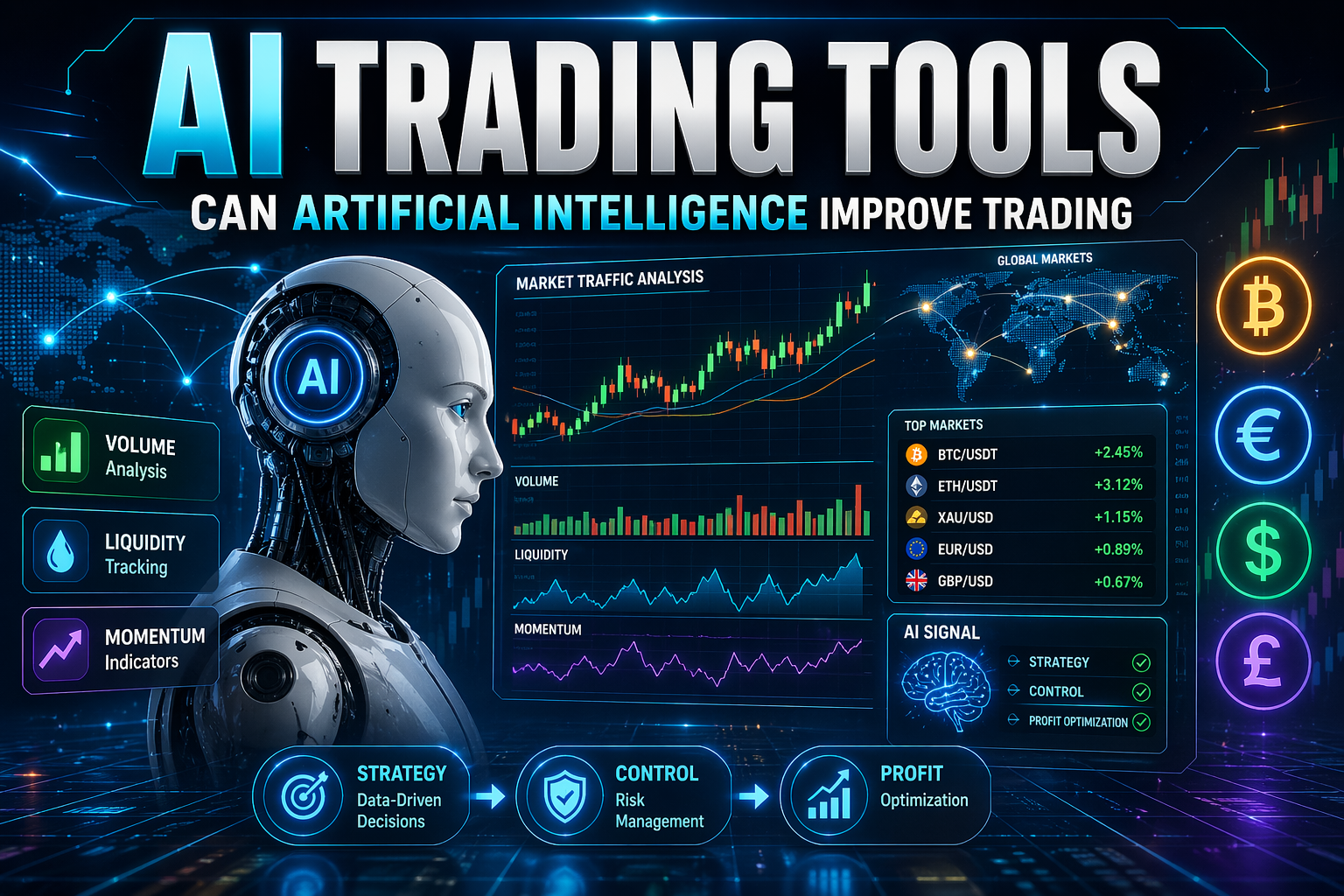
One of the key reasons AI is so effective is its ability to monitor market traffic, which includes volume, liquidity, and momentum. Understanding these elements is critical:
- Volume indicates the number of assets being traded, showing the market’s activity level.
- Liquidity reflects how easily assets can be bought or sold without affecting their price, helping traders identify optimal entry and exit points.
- Momentum measures the speed and direction of price movements, signaling potential trends or reversals.
AI tools can process this information in real-time, identifying opportunities that might take a human trader hours or even days to notice. By integrating these traffic insights, AI empowers traders to develop a more effective trading strategy, maintain better control over their decisions, and achieve profit optimization consistently.
But the question remains: “Can AI actually dominate the market for you?” While no tool can guarantee 100% success, leveraging AI for analyzing market traffic and optimizing strategy significantly increases the odds of outperforming traditional trading methods. In essence, AI doesn’t just assist—it can become a key driver of trading domination when used correctly.
2. What Are AI Trading Tools?
AI trading tools are advanced software platforms that use machine learning, predictive analytics, and automation to assist traders in making smarter, faster, and more data-driven decisions. Unlike traditional trading methods, which rely heavily on manual analysis or basic charting software, AI tools can process vast amounts of market data in real-time, identify patterns, and execute trades with minimal human intervention.
AI vs Traditional Trading Software vs Manual Analysis
Understanding the difference between AI tools and other trading methods is crucial:
- Manual Analysis
- Traders rely on personal research, charts, and experience to make decisions.
- While this allows for human intuition, it is often slow, prone to errors, and unable to process massive market traffic effectively.
- Traditional Trading Software
- Offers charting, alerts, and technical indicators.
- Supports decision-making but cannot analyze complex patterns in real-time or adapt strategies automatically.
- AI Trading Tools
- Combines the best of both worlds but adds intelligence: it learns from historical and live data, predicts market movements, and can even automate trades.
- Analyzes market traffic (volume, liquidity, momentum) continuously to optimize strategy, improve control, and maximize profits.
Types of AI Trading Tools
AI trading tools come in several forms, each serving a specific purpose for modern traders:
- Predictive Algorithms
- Use historical market data and machine learning to forecast price trends.
- Can identify high-probability opportunities in fast-moving markets.
- Trading Bots
- Automate buying and selling based on pre-set rules or AI-generated signals.
- React instantly to changes in volume, liquidity, and momentum, giving traders an edge in execution.
- Sentiment Analyzers
- Monitor news, social media, and other market sentiment indicators.
- Gauge market psychology to predict potential price movements or volatility spikes.
By combining these tools, traders can build a comprehensive AI-powered system that monitors market traffic, implements effective strategies, maintains control over trades, and drives profit optimization.
In short, AI trading tools are the modern trader’s secret weapon—they transform raw market data into actionable insights, helping traders stay ahead in an increasingly competitive market.
3. How AI Uses Market Traffic
One of the biggest advantages of AI trading tools is their ability to analyze market traffic—specifically volume, liquidity, and momentum—to predict price movements with precision. Unlike traditional methods, which often react to market changes after they happen, AI can process massive datasets in real-time, giving traders a significant edge.
Analyzing Volume, Liquidity, and Momentum
- Volume
- Represents the number of assets traded over a specific period.
- AI tools track sudden spikes or drops in volume to identify potential market moves.
- Example: A sharp increase in Bitcoin trading volume may signal the start of a bullish trend, prompting AI to alert or execute trades.
- Liquidity
- Measures how easily an asset can be bought or sold without impacting its price.
- Low liquidity can indicate higher risk, while high liquidity ensures smoother trades.
- AI monitors order books and liquidity pools across exchanges to choose optimal trade sizes and timing.
- Momentum
- Tracks the speed and direction of price changes.
- Momentum indicators help AI determine whether a trend is gaining strength or likely to reverse.
- Example: If Ethereum’s price accelerates rapidly with strong momentum, an AI bot may enter a position early to capture gains.
Real-Time Data Scanning
AI trading platforms continuously scan multiple markets, exchanges, and data sources. They analyze historical patterns, live volume spikes, liquidity fluctuations, and momentum shifts simultaneously. For instance:
- A trading bot may notice a sudden surge in liquidity in a lesser-known stock while volume is still moderate.
- Using predictive analytics, AI estimates that momentum will increase, triggering an automated buy order before the wider market reacts.
From Traffic Analysis to Trading Domination
By leveraging market traffic data, AI tools allow traders to:
- Optimize Strategy: Adjust entry, exit, and risk parameters based on real-time insights.
- Maintain Control: Avoid emotional decisions by relying on data-driven signals.
- Maximize Profit: Identify high-probability opportunities early, increasing the likelihood of profitable trades.
In essence, understanding and acting on volume, liquidity, and momentum isn’t just about making trades—it’s about achieving trading domination. Traders who harness AI to analyze market traffic can consistently stay one step ahead of competitors, turning insights into actionable strategies that maximize profit while minimizing risk.
4. Benefits of AI Trading Tools
Using AI trading tools offers traders a competitive advantage by leveraging market traffic—volume, liquidity, and momentum—more efficiently than traditional methods. These tools don’t just assist in trading; they transform how decisions are made, helping traders achieve strategy, control, and profit optimization.
1. Speed & Accuracy
AI can process massive amounts of data and execute trades instantly, far faster than any human trader.
- By monitoring market traffic in real-time, AI reacts to sudden spikes in volume, liquidity shifts, or momentum changes before the human eye can detect them.
- Example: During a major cryptocurrency pump, an AI bot can enter and exit positions in milliseconds, capturing profits while manual traders are still analyzing charts.
2. Emotion-Free Trading
Humans are prone to emotional decision-making—fear, greed, or panic can derail even the best strategies.
- AI tools remove this variable by strictly following data-driven rules.
- Example: In volatile Forex markets, AI prevents a trader from holding a losing position out of hope or selling too early out of fear, sticking to pre-programmed traffic-based signals.
3. Strategy Optimization
AI doesn’t just follow a strategy; it learns and improves continuously.
- By analyzing historical and real-time volume, liquidity, and momentum, AI can identify patterns and refine strategies for better performance.
- Example: A predictive algorithm in stock trading might adjust buy/sell thresholds after detecting a recurring pattern in trading volume spikes, increasing the probability of profitable trades.
4. Profit Maximization
AI tools are designed to maximize profits by analyzing high-probability trading opportunities.
- They combine insights from multiple traffic indicators to identify trades with the best risk-to-reward ratio.
- Example: A trading bot monitoring Ethereum notices rising momentum coupled with high liquidity and moderate volume. It executes trades automatically, capturing gains that a human trader might miss due to slower reaction times.
Real-World Success Stories
- Hedge Funds: Some hedge funds use AI to outperform the market by analyzing billions of data points per day, achieving higher returns than traditional fund managers relying on manual analysis.
- Crypto Traders: AI-driven bots on exchanges like Binance or Coinbase consistently execute trades faster than humans, capturing micro-opportunities in volatile markets.
- Stock Markets: Predictive AI algorithms have successfully anticipated trend reversals in stocks like Tesla or Apple by analyzing order book liquidity and momentum patterns.
In summary, the benefits of AI trading tools go beyond simple automation. By combining speed, accuracy, emotion-free decisions, strategy optimization, and profit maximization, traders can harness market traffic to achieve trading domination, consistently outperforming manual trading methods.
5. Common Types of AI Trading Tools
To truly leverage market traffic—volume, liquidity, and momentum—traders need the right AI trading tools. Modern AI platforms offer a range of tools that serve different purposes, from automating trades to analyzing sentiment and optimizing portfolios. Understanding these tools helps traders maximize strategy, control, and profit optimization.
1. Trading Bots
Trading bots are AI programs that automatically execute trades based on traffic signals and pre-set strategies.
- They monitor volume, liquidity, and momentum continuously to determine the best entry and exit points.
- Bots can react instantly to sudden market changes, far faster than human traders.
- Example: A bot detecting a sudden surge in Bitcoin’s volume combined with high momentum might automatically place a buy order, capturing profits before the wider market reacts.
Key Benefit: Automation reduces human error, ensures emotion-free decisions, and allows traders to capitalize on opportunities 24/7.
2. Predictive Analytics Platforms
Predictive analytics platforms use historical market data, machine learning, and statistical modeling to forecast price trends.
- These platforms identify patterns and predict potential price movements with high accuracy.
- They help traders anticipate shifts in volume, liquidity, and momentum, making proactive decisions possible.
- Example: In Forex trading, predictive analytics might forecast a likely uptrend in EUR/USD based on recurring liquidity spikes and momentum patterns, giving traders a strategic advantage.
Key Benefit: Traders can optimize strategies by acting on future probabilities rather than just reacting to current conditions.
3. Sentiment Analysis Tools
Sentiment analysis tools monitor the emotional and psychological aspects of the market.
- These tools scan news outlets, social media, and financial reports to gauge investor sentiment.
- By analyzing sentiment alongside market traffic, AI can detect potential market movements before they appear in traditional indicators.
- Example: A surge in positive sentiment about a tech stock, coupled with increasing trading volume and momentum, might signal a strong buying opportunity.
Key Benefit: Incorporating sentiment allows traders to anticipate market reactions that aren’t immediately visible in charts or volume data alone.
4. Portfolio Optimizers
Portfolio optimizers are AI tools designed to manage risk and maximize profits across multiple assets.
- They analyze traffic data, historical performance, and correlations between assets to optimize portfolio allocation.
- These tools automatically adjust positions to maintain balance between risk and reward, factoring in volume, liquidity, and momentum across markets.
- Example: An AI optimizer reallocates funds from low-liquidity stocks to high-momentum crypto assets during periods of volatility, ensuring maximum potential returns with minimized risk.
Key Benefit: Helps traders maintain control over complex portfolios while ensuring their strategy aligns with market traffic and profit goals.
6. Integrating AI Into Your Trading Strategy
Implementing AI trading tools effectively requires more than just installing software—it’s about aligning tools with your trading goals and using market traffic data to achieve strategy, control, and profit optimization. Here’s a step-by-step guide for integrating AI into your trading routine:
Step 1: Analyze Your Trading Goals and Traffic Indicators
Before selecting any AI tool, define what you want to achieve:
- Are you focusing on short-term gains or long-term growth?
- Which markets do you want to trade: Forex, cryptocurrencies, or stocks?
- Identify the key traffic indicators relevant to your strategy: volume, liquidity, and momentum.
- Example: If your goal is momentum trading in crypto, you’ll prioritize AI tools that can detect sudden spikes in trading volume and momentum shifts.
Key Tip: Understanding your goals ensures AI tools are used effectively rather than blindly following automated signals.
Step 2: Choose AI Tools Compatible With Your Style and Market Focus
Not all AI tools are created equal. Select tools that complement your trading approach:
- Trading bots for automated, fast-paced strategies.
- Predictive analytics platforms if your focus is trend forecasting.
- Sentiment analysis tools for news-driven or event-based trading.
- Portfolio optimizers for multi-asset strategies.
Example: A day trader might rely heavily on trading bots and predictive analytics, while a long-term investor may prioritize portfolio optimization and sentiment analysis.
Key Tip: Compatibility with your market focus ensures AI enhances your strategy instead of complicating it.
Step 3: Start With Demo Accounts to Test Strategies Safely
Before committing real funds, use demo accounts to evaluate your AI tools:
- Test how the AI reacts to market traffic in real-time.
- Experiment with different strategies and see which traffic signals produce the best results.
- Refine parameters like stop-loss, take-profit, and risk allocation based on AI feedback.
Example: A demo account allows you to simulate a high-liquidity crypto market scenario without risking actual capital, helping you understand how AI decisions align with your goals.
Key Tip: Testing minimizes risk and builds confidence in AI-driven strategies.
Step 4: Gradually Scale Using AI-Driven Traffic Insights
Once you’re confident in your strategy, gradually transition to live trading:
- Start with small positions to test AI performance in real market conditions.
- Monitor traffic indicators closely and adjust strategy as needed.
- Scale trades incrementally as the AI demonstrates consistent performance.
Example: An AI bot may start with $500 trades on a volatile crypto pair, gradually increasing to larger positions as confidence and results grow.
Key Tip: Controlled scaling prevents overexposure while leveraging AI insights for maximum profit.
Step 5: Apply the Domination Formula
Integrating AI successfully is not just about automation—it’s about achieving market domination. Follow this proven formula:
Traffic Analysis → Strategy → Control → Profit Optimization
- Traffic Analysis: Use AI to monitor volume, liquidity, and momentum.
- Strategy: Refine your trading plan based on real-time AI insights.
- Control: Maintain discipline and minimize emotional bias.
- Profit Optimization: Capture high-probability trades and maximize returns.
By systematically applying this formula, traders can turn raw market data into actionable insights, dominate their chosen markets, and consistently optimize profits.
7. Risks and Limitations of AI in Trading
While AI trading tools offer incredible advantages in analyzing market traffic—volume, liquidity, and momentum—they are not infallible. Understanding the risks and limitations of AI is essential to maintain control, optimize profits, and avoid costly mistakes.
1. Over-Reliance on AI Without Understanding Market Traffic
- Many traders make the mistake of blindly trusting AI signals without comprehending the underlying volume, liquidity, and momentum dynamics.
- AI can provide recommendations, but it cannot replace human judgment in interpreting complex or unusual market conditions.
- Example: A bot may trigger a buy signal during a sudden liquidity spike, but without understanding the context, a trader could be entering a short-lived, high-risk situation.
Key Takeaway: Use AI as a tool, not a crutch. Knowledge of market traffic ensures smarter decisions and sustainable trading domination.
2. Risk of Incorrect Predictions in Volatile Conditions
AI tools rely on historical data, statistical models, and predictive algorithms to forecast market movements.
- During extreme volatility or unprecedented events, these predictions can fail, leading to losses.
- Example: A sudden geopolitical event or unexpected news release may disrupt momentum patterns, causing AI predictions to misfire.
Key Takeaway: Always monitor AI signals alongside current market conditions. Combining traffic analysis with human oversight reduces the impact of unpredictable events.
3. Technical Failures or Misconfigurations
- AI tools are complex systems that require proper setup, updates, and maintenance.
- Errors in configuration, software glitches, or connectivity issues can lead to missed opportunities or unintended trades.
- Example: A misconfigured trading bot might execute trades at the wrong price or time, undermining both strategy and profit goals.
Key Takeaway: Regularly check, test, and maintain AI tools to ensure they perform reliably and align with your trading objectives.
4. Mitigating Risks Through Oversight and Management
To minimize AI risks and maintain control:
- Combine AI insights with personal analysis of market traffic.
- Use demo accounts to test strategies before deploying real capital.
- Set risk management parameters, including stop-loss and position limits.
- Continuously monitor AI performance, adapting strategies when needed.
By understanding and respecting these limitations, traders can harness the full potential of AI while maintaining strategy, control, and profit optimization. Proper oversight ensures AI tools enhance performance rather than introduce avoidable risks.
Best Crypto Trading Bots in 2026 (Detailed Comparison)
8. Case Studies: AI Success in Trading
AI trading tools are not just theoretical; they have proven success in real-world trading. By analyzing market traffic—volume, liquidity, and momentum—AI empowers traders to make faster, smarter, and more profitable decisions. Below are examples of how AI has transformed trading performance in both crypto and Forex markets.
1. Increased Reaction Speed to High Liquidity Events
Scenario: A cryptocurrency exchange experiences a sudden spike in liquidity for Ethereum due to a major market announcement.
- AI Action: An AI trading bot detects the liquidity surge in real-time and automatically executes buy orders before manual traders can respond.
- Outcome: Traders using AI captured profits from the price movement within seconds, a feat impossible with traditional analysis.
- Takeaway: AI leverages volume and liquidity data to act faster than human traders, ensuring a competitive edge.
2. Enhanced Momentum Trading with Predictive Analytics
Scenario: In Forex markets, a trader wants to capitalize on short-term momentum in the EUR/USD pair.
- AI Action: A predictive analytics platform analyzes historical and real-time data to identify emerging momentum patterns. The AI signals an entry point aligned with increasing momentum.
- Outcome: Trades executed based on AI predictions captured profits that would have been missed using manual strategies.
- Takeaway: Combining momentum analysis with predictive AI improves the accuracy of trend-based strategies, leading to higher success rates.
3. Optimized Profits Through Automated Strategies
- Scenario: A crypto trader manages multiple assets across volatile markets and wants to maximize returns without constant monitoring.
- AI Action: Portfolio-optimizing AI tools automatically adjust positions based on traffic signals, redistributing funds to high-momentum, high-liquidity assets.
- Outcome: The trader sees consistent profit growth while reducing exposure to riskier, low-liquidity trades.
- Takeaway: AI transforms traffic insights into strategy, control, and profit optimization, allowing traders to dominate complex markets effortlessly.
Cross-Market Relevance
These examples demonstrate that AI trading tools are effective across multiple markets:
- Cryptocurrency: Rapidly changing liquidity and momentum patterns make AI automation essential for fast decision-making.
- Forex: Predictive analytics and volume monitoring help traders capitalize on trend reversals and high-probability opportunities.
By analyzing market traffic and executing data-driven strategies, AI gives traders a tangible advantage over manual trading. These case studies show that mastering AI tools is not just about automation—it’s about achieving trading domination through speed, precision, and profit optimization.
9. Future of AI in Trading
The future of trading is being reshaped by Artificial Intelligence, and its evolution promises even greater opportunities for traders who understand market traffic—volume, liquidity, and momentum. Emerging trends indicate that AI will not only assist in decision-making but will become a central driver of strategy, control, and profit optimization.
1. AI Learning from Global Traffic Patterns
- Future AI tools are expected to analyze global market traffic across multiple exchanges, asset classes, and regions.
- By learning from patterns in volume, liquidity, and momentum worldwide, AI can predict market trends with unprecedented accuracy.
- Example: An AI platform could detect correlated liquidity spikes in cryptocurrencies across different exchanges, signaling an upcoming market shift before it becomes apparent to most traders.
- Takeaway: Leveraging global traffic patterns allows traders to act proactively, staying ahead of the market instead of reacting to it.
2. Integration with Blockchain and Decentralized Finance (DeFi)
- AI is increasingly being integrated with blockchain technology and DeFi platforms, enabling smarter automated trading in decentralized environments.
- AI can monitor on-chain metrics such as transaction volume, liquidity pools, and token momentum to execute high-precision trades.
- Example: In a DeFi yield farming scenario, AI could detect a sudden surge in liquidity in a specific pool and automatically allocate funds to maximize returns while mitigating risk.
- Takeaway: AI integration with DeFi expands the scope of traffic analysis, turning decentralized markets into strategic opportunities for profit optimization.
3. Predictive Models Combining Sentiment, Volume, Liquidity, and Momentum
- The next generation of AI trading tools will not rely solely on historical price data—they will combine multiple traffic indicators and market sentiment.
- By analyzing news, social media trends, volume spikes, liquidity shifts, and momentum, predictive AI can anticipate high-probability trades with greater accuracy.
- Example: A predictive AI model may detect rising positive sentiment around a cryptocurrency alongside increasing volume and liquidity, signaling a strong buy opportunity.
- Takeaway: Multi-dimensional traffic analysis ensures traders maintain control and consistently optimize profits in complex market conditions.
4. Mastery of AI + Traffic Analysis = Market Domination
- As AI continues to evolve, traders who integrate these tools into their strategies while understanding market traffic will gain a decisive edge.
- Mastery of AI doesn’t mean passive reliance—it means using AI insights to refine strategy, maintain control, and maximize profits.
- Formula for Future Success: Traffic (Volume, Liquidity, Momentum) + AI Mastery = Trading Domination
By staying ahead of AI trends and combining them with deep knowledge of traffic patterns, traders can secure long-term success and consistently outperform markets dominated by human-only strategies.
10. Conclusion: Can AI Improve Your Trading?
Artificial Intelligence is no longer just a futuristic concept—it has become a powerful ally for modern traders. From analyzing market traffic to optimizing trading strategies, AI tools are helping traders make faster, smarter, and more profitable decisions.
By integrating AI, traders gain deeper insights into volume, liquidity, and momentum, enabling them to anticipate market movements with a level of precision that’s difficult to achieve manually. AI doesn’t just automate trades; it enhances your ability to develop a winning trading strategy, maintain disciplined control, and maximize profit optimization.
Reinforcing the Traffic → Domination Formula
At TrafficDomination.net, we emphasize a clear, actionable formula for success:
Traffic (Volume, Liquidity, Momentum) → Domination (Strategy, Control, Profit Optimization)
- Traffic Analysis: Use AI tools to monitor volume, liquidity, and momentum in real-time.
- Strategy Development: Leverage these insights to refine entry and exit points, risk management, and trade planning.
- Control: Minimize emotional decisions and maintain discipline with AI-driven recommendations.
- Profit Optimization: Execute high-probability trades efficiently to maximize gains while reducing risk exposure.
When applied consistently, this formula ensures that traders aren’t just reacting to the market—they are dominating it.
Call-to-Action
For traders ready to take their skills to the next level:
- Explore AI Trading Tools: Evaluate trading bots, predictive analytics, sentiment analyzers, and portfolio optimizers to find what aligns with your style.
- Start with Demo Accounts: Test strategies safely and understand how AI reacts to market traffic.
- Integrate AI for Real Trading Domination: Apply insights from AI tools alongside your knowledge of traffic indicators to consistently improve performance and profitability.
By embracing AI and mastering market traffic, traders can turn data into actionable strategies, positioning themselves ahead of competitors and consistently achieving trading domination.