
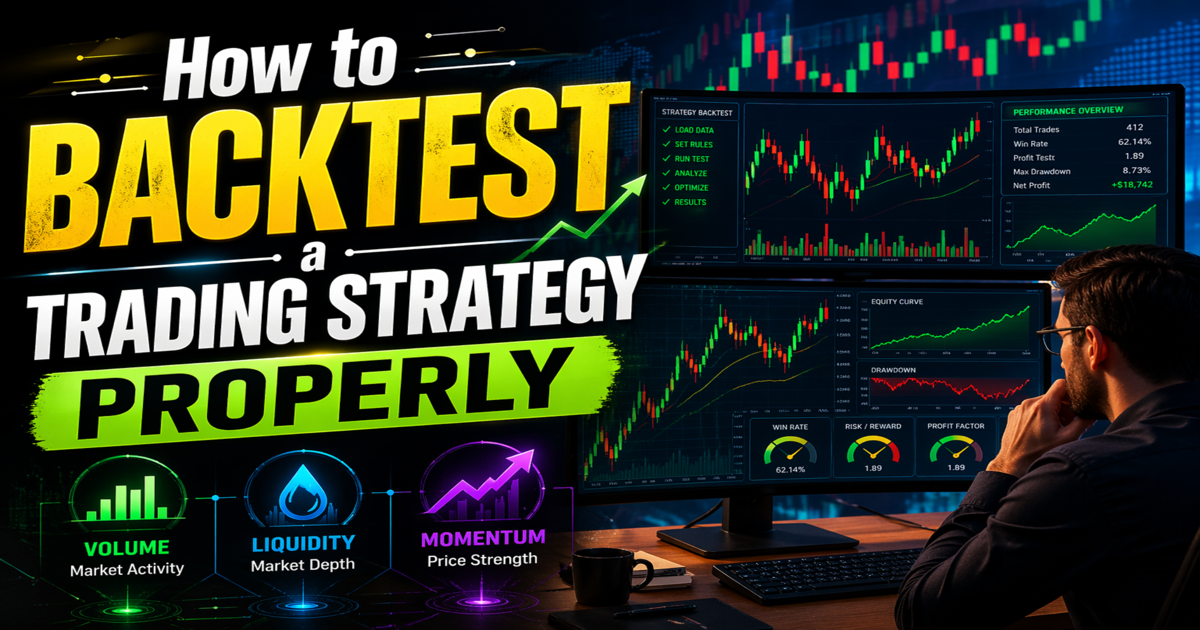
1. Understanding Backtesting in Trading
Backtesting is one of the most important steps in building a profitable trading system. It is the process of applying a trading strategy to historical market data in order to evaluate how the strategy would have performed in the past.
Instead of relying on assumptions or emotions, backtesting allows traders to use real market history to determine whether a strategy has a statistical edge. By analyzing past price movements, traders can simulate trades and measure how a strategy responds to different market conditions.
For example, if a trader develops a strategy based on a moving average crossover, backtesting allows them to apply that strategy to years of historical charts. This reveals whether the strategy consistently generates profits or produces excessive losses.
Backtesting transforms trading from guesswork into data-driven decision making.
At its core, proper backtesting answers one critical question:
Does this strategy actually work in real market conditions?
When performed correctly, backtesting provides traders with valuable insights into several key performance metrics.
Profitability
Profitability measures whether a trading strategy produces overall gains over time.
A strategy might generate many trades, but if the total losses exceed the profits, the strategy is not viable. Backtesting allows traders to calculate:
- total profit generated
- average profit per trade
- cumulative account growth
This helps traders determine whether a strategy is capable of producing consistent long-term returns rather than short-term luck.
Win Rate
The win rate represents the percentage of trades that end in profit.
For example:
- 60 winning trades out of 100 trades = 60% win rate
However, win rate alone does not determine profitability. Some strategies have a lower win rate but remain profitable due to larger reward targets compared to losses.
Backtesting helps traders understand how win rate interacts with risk-reward ratios and market volatility.
Risk Exposure
Risk exposure refers to how much capital is placed at risk during each trade.
During backtesting, traders evaluate:
- position sizing
- percentage risk per trade
- capital allocation across trades
This analysis ensures that a strategy does not expose the trading account to excessive drawdowns or catastrophic losses.
Professional traders typically risk 1–2% of their capital per trade, and backtesting helps confirm whether that risk level is sustainable.
Maximum Drawdown
Maximum drawdown measures the largest decline in account value during the testing period.
For example:
- an account grows from $10,000 to $12,000
- then drops to $9,500
The drawdown from the peak would represent the maximum drawdown.
This metric is extremely important because even profitable strategies can experience periods of losses. Backtesting helps traders determine whether they can psychologically and financially tolerate those losing streaks.
Strategies with extremely high drawdowns are often too risky for real trading.
Market Condition Performance
Financial markets constantly shift between different conditions, such as:
- trending markets
- sideways consolidation
- high volatility environments
- low liquidity periods
A strategy that performs well during strong trends may struggle during ranging markets. Backtesting allows traders to see how their strategy performs across multiple market environments.
By analyzing performance under different conditions, traders can determine:
- when a strategy works best
- when to avoid trading
- how to adapt strategies to changing markets
Understanding these conditions is crucial for achieving consistent long-term trading success.
Why Backtesting Matters
Backtesting is not just a technical exercise—it is a fundamental step toward becoming a disciplined and profitable trader.
Many beginners jump directly into live markets without properly testing their strategies. This often leads to emotional decision-making, inconsistent performance, and significant financial losses.
Backtesting helps traders build confidence in their systems and develop a structured, evidence-based trading approach.
Validate Trading Strategies
One of the main benefits of backtesting is strategy validation.
A trading strategy might appear promising when viewed on a chart, but only historical testing can confirm whether it has real statistical value.
Backtesting allows traders to answer critical questions:
- Does the strategy produce consistent profits?
- Does it perform well across different market cycles?
- Does it maintain a favorable risk-reward balance?
Without validation, traders risk relying on strategies that are unreliable or purely coincidental.
Identify Weaknesses
Every trading strategy has limitations.
Backtesting helps traders identify weaknesses such as:
- poor performance during certain market conditions
- excessive drawdowns
- inconsistent entry signals
- high sensitivity to volatility
By identifying these weaknesses early, traders can modify or improve their strategy before risking real capital.
This process allows traders to refine their approach and eliminate structural flaws.
Improve Risk Management
Risk management is one of the most critical aspects of successful trading.
Backtesting enables traders to experiment with different risk parameters, such as:
- stop-loss distances
- position sizing
- risk-reward ratios
Through this analysis, traders can determine which risk settings produce the most stable long-term results.
Effective risk management ensures that even during losing streaks, traders maintain capital preservation and account longevity.
Avoid Costly Mistakes in Live Markets
Trading without backtesting is similar to launching a business without testing the product.
Many traders lose money simply because they begin trading strategies that have never been proven to work.
Backtesting significantly reduces this risk by allowing traders to simulate trades in a risk-free environment.
This process helps traders:
- avoid emotional decisions
- eliminate flawed strategies
- enter live markets with confidence
Backtesting vs Gambling
Without backtesting, trading becomes speculative and unpredictable.
When traders enter positions without testing their strategies, they are essentially relying on luck rather than data.
Professional traders, hedge funds, and algorithmic trading firms always test their strategies extensively before deploying capital. Backtesting ensures that decisions are based on statistical evidence rather than guesswork.
In this sense, backtesting represents the difference between professional trading and gambling.
2. The Role of Market Traffic in Backtesting
Successful backtesting involves much more than simply analyzing price charts. While price movements provide valuable information, professional traders understand that market behavior is driven by deeper forces. These forces are what we refer to as market traffic dynamics.
In the Traffic Domination framework, traffic represents the underlying activity within financial markets. It consists of three critical components:
Market Volume, Liquidity, and Momentum.
When traders include these factors in their backtesting process, they gain a deeper understanding of how their strategies perform under different market conditions. Instead of relying solely on price patterns, they evaluate the actual market activity driving those price movements.
By analyzing market traffic, traders can determine whether their strategies perform best during periods of high activity, strong trends, or stable market environments.
Market Volume
Market volume represents the total number of transactions or contracts traded during a specific period of time. It is one of the most widely used indicators for understanding market participation.
Volume reveals how much interest traders and institutions have in a particular asset. When large numbers of participants are buying and selling, volume increases, indicating that the market is active and engaged.
High volume generally indicates:
- Strong market participation – More buyers and sellers are entering the market.
- Stronger price movements – Larger trading activity often leads to more significant price changes.
- Better trade reliability – Price movements supported by high volume are usually more trustworthy.
For example, if a breakout occurs above a resistance level with high volume, it suggests that many traders support the move. This increases the probability that the breakout will continue.
On the other hand, a breakout with low volume may indicate a weak move that could quickly reverse.
During backtesting, traders analyze historical volume levels to determine:
- whether their strategy performs better in high-volume environments
- how volume spikes influence entry and exit signals
- whether certain trading sessions generate more reliable trades
Understanding volume behavior helps traders identify when the market is active enough to support profitable opportunities.
Liquidity
Liquidity refers to how easily an asset can be bought or sold without significantly affecting its price. Highly liquid markets have a large number of buyers and sellers ready to execute trades.
Markets with strong liquidity tend to function more efficiently because orders can be executed quickly and at predictable prices.
Higher liquidity typically results in:
- Tighter spreads between bid and ask prices
- Faster order execution with minimal delays
- Reduced slippage, meaning traders receive prices close to their intended entries
Liquidity is particularly important for traders who rely on short-term strategies, such as scalping or day trading. In these strategies, even small differences in execution price can significantly impact profitability.
For example:
- Major currency pairs in the Forex market tend to have high liquidity, making them ideal for many trading strategies.
- Exotic currency pairs or low-volume assets may have lower liquidity, leading to wider spreads and unpredictable price movement.
When backtesting, traders analyze liquidity conditions to determine whether their strategy performs better during:
- major trading sessions (London or New York sessions)
- periods of high institutional participation
- times when spreads are tight and execution is efficient
By incorporating liquidity analysis into backtesting, traders can design strategies that operate under realistic trading conditions.
Momentum
Momentum measures the strength and speed of price movement in a particular direction. It reflects the intensity of buying or selling pressure within the market.
When momentum is strong, prices tend to move quickly and persistently in one direction. When momentum weakens, price movements slow down or begin to reverse.
Momentum-driven markets often produce:
- Breakout opportunities when price escapes from consolidation zones
- Trend continuation patterns as strong movements extend existing trends
- Volatility expansion, where price swings become larger and more frequent
Momentum is particularly important for strategies that rely on trend-following or breakout trading. In these strategies, identifying strong directional movement is essential for capturing larger profits.
During backtesting, traders evaluate how their strategies perform during:
- strong bullish momentum
- strong bearish momentum
- low-momentum consolidation phases
For example, a trend-following strategy may perform extremely well during high-momentum markets but struggle when price moves sideways.
Understanding momentum patterns allows traders to identify the optimal conditions for their strategy to succeed.
Analyzing Market Traffic in Backtesting
When traders combine volume, liquidity, and momentum analysis, they gain a complete picture of market traffic behavior.
Instead of asking only “Did the price move?”, traders begin asking deeper questions such as:
- Was the move supported by high trading volume?
- Did the market have sufficient liquidity for efficient execution?
- Was the price move driven by strong momentum?
By studying these factors during backtesting, traders can determine whether their strategy performs better in specific environments, such as:
- Trending markets, where momentum drives sustained price movement
- Ranging markets, where price oscillates within support and resistance levels
- High-liquidity trading sessions, when institutional activity increases
This type of analysis helps traders refine their strategies so they are applied only when market conditions are favorable.
Market Traffic as the Foundation of Strategy Performance
Many strategies fail not because the concept is flawed, but because traders apply them during unfavorable market conditions.
For example:
- A breakout strategy may fail in low-volume markets.
- A trend-following system may struggle during sideways conditions.
- A scalping strategy may lose effectiveness in low-liquidity environments.
Backtesting with market traffic analysis helps traders identify these limitations and adjust their approach accordingly.
This is why understanding traffic patterns is critical for long-term trading success.
3. Define a Clear Trading Strategy Before Backtesting
Before beginning any backtesting process, traders must first develop a clearly defined trading strategy. A strategy cannot be tested properly if its rules are vague, inconsistent, or based on subjective interpretation.
Backtesting works by applying specific rules to historical market data. If those rules are not clearly defined, the testing results will be unreliable because different decisions could be made each time the strategy is applied.
In professional trading, strategies must be structured, repeatable, and measurable. Every trade decision—whether entering or exiting the market—should be based on predefined conditions rather than emotions or personal judgment.
A properly defined trading strategy typically includes three main components:
- Entry rules
- Exit rules
- Risk management rules
When these elements are clearly established, traders can evaluate whether a strategy performs consistently across different market conditions.
Entry Rules
Entry rules define when a trader should open a position in the market. These rules identify the specific conditions that must occur before a trade is executed.
A good entry rule removes uncertainty by clearly answering the question:
“Under what conditions should I enter the market?”
Entry rules are usually based on technical indicators, price patterns, or market behavior signals. Some common examples include:
Moving Average Crossover
A moving average crossover strategy occurs when a short-term moving average crosses above or below a long-term moving average.
Typical signals include:
- Bullish signal: short-term average crosses above the long-term average
- Bearish signal: short-term average crosses below the long-term average
This strategy attempts to capture new trends as they begin to form.
RSI Oversold Condition
The Relative Strength Index (RSI) is a momentum indicator that measures whether an asset is overbought or oversold.
Common entry signals include:
- buying when RSI drops below 30 (oversold condition)
- selling when RSI rises above 70 (overbought condition)
Traders use this approach to identify potential price reversals.
Breakout Above Resistance
Breakout strategies focus on entering the market when price moves beyond a key support or resistance level.
For example:
- entering a buy trade when price breaks above resistance
- entering a sell trade when price breaks below support
Breakouts often occur during periods of increasing market volume and momentum, making them popular strategies for capturing strong price movements.
When defining entry rules, traders should specify precise conditions such as:
- the exact indicator settings
- the timeframe used
- confirmation signals required
Clear entry rules ensure that every trade follows the same criteria, making the strategy easier to test objectively.
Exit Rules
Exit rules determine when a trader closes a position, either to secure profits or limit losses. While many traders focus heavily on entry signals, experienced traders understand that exit strategy is equally important for long-term profitability.
Exit rules protect trading capital and help maintain consistency in performance.
Common exit strategies include the following.
Stop Loss Levels
A stop loss is a predefined price level where a trade is automatically closed if the market moves against the trader.
For example:
- entering a trade at $100
- placing a stop loss at $95
If the price falls to $95, the trade closes to prevent further losses.
Stop losses are essential for controlling risk and preventing a single trade from causing significant damage to a trading account.
Take Profit Targets
A take profit order closes a trade once a predetermined profit level is reached.
For example:
- entering a trade at $100
- placing a take profit at $110
If price reaches $110, the trade automatically closes and locks in profits.
Take profit targets allow traders to maintain discipline and avoid emotional decision-making.
Trailing Stop Strategies
A trailing stop adjusts automatically as price moves in the trader’s favor.
For example:
- a trailing stop may follow the price at a fixed distance
- if the price continues rising, the stop moves upward
- if the price reverses, the stop locks in profits
Trailing stops allow traders to capture larger trends while protecting gains.
Defining clear exit rules ensures that every trade follows the same risk and reward structure during backtesting.
Risk Management
Risk management is one of the most critical components of any successful trading strategy. Even profitable strategies can fail if risk is not properly controlled.
Risk management rules define how much capital is exposed during each trade and how losses are managed over time.
Key risk parameters include the following.
Position Size
Position size refers to the number of units, shares, or contracts traded in a single position.
Position size should be determined based on:
- account balance
- stop loss distance
- acceptable risk level
Proper position sizing prevents traders from placing trades that are too large relative to their account size.
Percentage Risk per Trade
Professional traders typically limit the amount of capital risked on each trade.
Common guidelines include risking:
- 1% of account balance per trade
- 2% maximum for higher-risk strategies
This approach protects trading accounts from severe losses during losing streaks.
Risk-Reward Ratio
The risk-reward ratio compares the potential profit of a trade to its possible loss.
For example:
- risking $100 to make $300 results in a 1:3 risk-reward ratio
Strategies with favorable risk-reward ratios can remain profitable even with lower win rates.
Understanding risk-reward relationships is essential for maintaining long-term profitability and capital preservation.
4. Choose the Right Historical Data
The accuracy and reliability of any backtest depend heavily on the quality of historical market data used during testing. Even the most sophisticated trading strategy can produce misleading results if it is tested using incomplete, inaccurate, or insufficient data.
Historical data serves as the foundation of the backtesting process. It provides the past market conditions that allow traders to simulate how their strategies would have performed over time. If the data is flawed, the backtest results will also be flawed, which may lead traders to trust strategies that fail in real markets.
Therefore, selecting the right historical dataset is a crucial step when building a data-driven trading strategy.
Several important factors must be considered when choosing historical market data for backtesting.
Data Length
One of the most important factors in backtesting is the length of the historical data period used for testing.
A common mistake among beginners is testing strategies on a very small dataset, such as a few weeks or months of price data. While this may show promising results, it does not provide enough evidence that the strategy can survive long-term market fluctuations.
For more reliable analysis, traders should ideally test their strategies on at least:
2–5 years of historical market data.
Using several years of data allows traders to observe how their strategy performs across different phases of the market cycle. Over longer time periods, markets experience a wide range of behaviors, including strong trends, sudden reversals, and periods of consolidation.
Longer datasets help traders determine whether their strategy performs consistently or whether its success depends on specific short-term conditions.
For example:
- A strategy that performs well in a short bullish market period may fail when market sentiment changes.
- A longer dataset helps reveal these weaknesses before real capital is at risk.
In professional trading environments, many quantitative analysts test strategies using 10 years or more of historical data to ensure robust performance.
Market Conditions
Financial markets constantly transition between different phases, each with unique characteristics. A strategy that performs well in one type of market environment may struggle in another.
For this reason, backtesting should include historical data that represents multiple types of market conditions.
Some of the most important conditions to include are:
Bull Markets
Bull markets occur when asset prices rise consistently over time. These periods are characterized by:
- strong upward trends
- increased investor confidence
- high buying pressure
Trend-following strategies often perform well during bullish environments because price movements tend to continue in the same direction.
Testing a strategy during bull markets helps traders determine whether it can capture sustained upward momentum.
Bear Markets
Bear markets represent periods of declining asset prices and negative investor sentiment. These environments often include:
- persistent downward trends
- increased volatility
- strong selling pressure
Some strategies that perform well during bullish trends may struggle during bearish periods. Backtesting during bear markets helps determine whether a strategy can handle downward momentum or market instability.
This analysis is especially important for traders who operate in markets such as cryptocurrency, stocks, or Forex, where sudden downturns can occur.
Sideways Markets
Sideways or ranging markets occur when prices move within a horizontal range without a clear trend.
These environments are characterized by:
- repeated support and resistance levels
- lower directional momentum
- consolidation patterns
Trend-following strategies often perform poorly in sideways markets because price repeatedly reverses before a trend develops.
However, range-trading strategies may perform well in these conditions.
Including sideways market periods in backtesting helps traders determine whether their strategy can adapt to non-trending environments.
High Volatility Periods
Volatility refers to the speed and magnitude of price changes. Some market periods experience extreme volatility due to major economic events, geopolitical developments, or shifts in investor sentiment.
High volatility environments may include:
- rapid price swings
- sudden market breakouts
- increased trading volume
Strategies that work in stable markets may behave very differently during volatile conditions.
Backtesting across volatile periods helps traders evaluate:
- how their strategy responds to sudden price movements
- whether risk management rules remain effective
- how drawdowns behave during market turbulence
Including these environments ensures that strategies are prepared for real-world market uncertainty.
Accurate Market Data
In addition to having a long and diverse dataset, it is also essential that the historical data itself is accurate and complete.
Most backtesting systems rely on what is known as OHLCV data, which includes the following components:
- Open Price – the price at which the asset begins trading during a specific time period
- High Price – the highest price reached during that period
- Low Price – the lowest price reached during that period
- Close Price – the final price at the end of the period
- Volume – the total amount of trading activity during that period
These five data points provide a comprehensive picture of market behavior during each time interval.
Accurate OHLCV data allows traders to:
- simulate realistic trade entries and exits
- analyze price volatility and momentum
- evaluate how volume influences market movements
For more advanced backtesting, traders may also use tick data or minute-level data, which provides even greater detail about price fluctuations and order execution.
Why High-Quality Data Matters
Poor-quality data can produce false or misleading backtesting results. If the historical data contains errors, missing values, or unrealistic price movements, the backtest may show profits that would never occur in real markets.
Common problems with low-quality data include:
- incorrect price records
- missing volume information
- unrealistic spreads or execution prices
- incomplete market history
These issues can distort strategy performance and create false confidence in a trading system.
By using reliable and comprehensive historical data, traders ensure that their backtests reflect realistic market behavior.
5. Select a Backtesting Method
Once a trading strategy has been clearly defined and the appropriate historical data has been selected, the next step is choosing how the backtest will be performed. The method used for backtesting can significantly influence the depth of analysis and the speed at which results are obtained.
In trading, there are two primary approaches to backtesting:
- Manual Backtesting
- Automated Backtesting
Both methods have their own advantages and limitations. The best choice often depends on the trader’s experience level, available tools, and the complexity of the strategy being tested.
Understanding these methods allows traders to select the most effective approach for evaluating their strategy and refining their trading system.
Manual Backtesting
Manual backtesting involves reviewing historical price charts and simulating trades based on the strategy’s rules. The trader moves through past market data candle by candle, identifying entry signals, placing hypothetical trades, and recording the results.
This process often involves using charting platforms to scroll through past price action and noting trades in a spreadsheet or trading journal.
For example, a trader using a breakout strategy might:
- scroll back several months or years on a chart
- wait for a price breakout above resistance
- simulate entering the trade
- record the entry price, stop loss, and exit point
Each trade is manually recorded to track the strategy’s performance over time.
Advantages of Manual Backtesting
Manual backtesting offers several benefits, particularly for beginners who are still learning how markets behave.
1. Great for Beginners
Manual testing helps new traders develop a deeper understanding of market structure, price action, and trading signals. By reviewing historical charts step by step, traders learn to recognize patterns and understand how strategies interact with real market conditions.
This hands-on experience builds valuable chart analysis skills that cannot always be gained through automated tools alone.
2. Improves Chart Reading Skills
Because manual backtesting requires traders to analyze charts carefully, it strengthens their ability to identify:
- support and resistance levels
- trend patterns
- breakout formations
- market reversals
Over time, this process improves a trader’s visual recognition of market behavior, which is essential for discretionary trading strategies.
Disadvantages of Manual Backtesting
Despite its educational value, manual backtesting has some significant limitations.
1. Time Consuming
One of the biggest drawbacks is the amount of time required. Testing a strategy across several years of historical data may involve analyzing hundreds or even thousands of trades.
Manually reviewing this data can take many hours or even days, making it difficult to test multiple strategies efficiently.
2. Human Bias
Manual testing also introduces the risk of human bias. Traders may unintentionally make decisions based on knowledge of what happens later in the chart.
For example, if a trader can see that price eventually rises, they might subconsciously choose better entry points than they would in real trading. This creates unrealistic results known as look-ahead bias.
Because of these limitations, manual backtesting is often best used as a learning tool or for testing simple strategies.
Automated Backtesting
Automated backtesting uses software programs and algorithms to apply trading strategies to historical market data automatically. Instead of manually reviewing charts, traders program the strategy rules into a system that executes the test across large datasets.
Several popular platforms and tools support automated backtesting, including:
- TradingView strategy testing tools
- MetaTrader expert advisors and strategy testers
- Python-based trading frameworks used by quantitative traders
Once the strategy rules are defined, the software runs the backtest across thousands of historical data points and generates detailed performance statistics.
Advantages of Automated Backtesting
Automated testing offers several powerful advantages that make it the preferred method for many professional traders.
1. Faster Testing
Automated systems can process large datasets within seconds or minutes. What might take hours or days using manual backtesting can be completed almost instantly using automated tools.
This allows traders to:
- test multiple strategies quickly
- evaluate different indicator settings
- optimize parameters efficiently
Speed is especially important when analyzing years of historical market data.
2. Larger Datasets
Automated systems can easily analyze thousands of trades across many years of historical data. This provides a much larger sample size than manual testing, which leads to more statistically reliable results.
With large datasets, traders can better evaluate:
- win rates
- drawdowns
- profitability consistency
- strategy performance across market cycles
A larger dataset reduces the likelihood that results are based on random market events.
3. More Accurate Statistics
Automated backtesting tools generate detailed performance metrics such as:
- profit factor
- maximum drawdown
- average trade return
- risk-adjusted performance ratios
These metrics provide a deeper understanding of a strategy’s strengths and weaknesses. Because automated systems follow predefined rules precisely, they eliminate human bias and produce more objective results.
Choosing the Right Method for Your Strategy
Both manual and automated backtesting methods have their place in a trader’s development.
Manual backtesting is particularly useful for:
- beginners learning market behavior
- discretionary trading strategies
- improving chart analysis skills
Automated backtesting is more suitable for:
- complex trading strategies
- algorithmic trading systems
- testing large datasets quickly
- generating detailed statistical analysis
Many experienced traders combine both approaches. They may begin with manual backtesting to understand strategy behavior, and then use automated tools to validate the strategy on larger datasets.
Backtesting Methods and the Traffic Domination Framework
Within the Traffic Domination philosophy, backtesting methods help traders transform raw market data into strategic insights.
The core principle remains:
Traffic = Market Volume, Liquidity, Momentum
Domination = Strategy, Control, Profit Optimization
Automated backtesting, in particular, allows traders to analyze how strategies perform during different traffic conditions, such as:
- high trading volume environments
- strong momentum trends
- periods of high or low liquidity
By analyzing these patterns across large datasets, traders gain a deeper understanding of market behavior dynamics.
6. Set Realistic Trading Conditions
One of the most common mistakes traders make during backtesting is testing strategies under unrealistic conditions. While historical data can reveal valuable insights, the results will only be meaningful if the testing environment closely reflects real-world trading conditions.
Many beginners run backtests that assume perfect execution, zero costs, and unlimited capital. In reality, trading always involves various costs and limitations that can significantly impact profitability.
To obtain accurate results, a proper backtest must simulate the same conditions that traders will face in live markets. This includes accounting for factors such as trading fees, slippage, and realistic account sizes.
Ignoring these elements may produce a strategy that looks highly profitable in testing but performs poorly when applied in real trading.
Trading Fees
Every trade executed in financial markets involves some form of transaction cost. These costs may appear small on individual trades, but they accumulate over time and can significantly reduce overall profits.
During backtesting, traders must incorporate these trading costs to produce realistic performance results.
Common trading fees include the following.
Broker Commissions
Many brokers charge a commission for executing trades. This fee may be applied:
- per trade
- per contract
- per lot size
For example, a broker might charge $5 per trade or a percentage of the trade value. If a strategy executes hundreds of trades per year, these commissions can substantially affect total profitability.
When backtesting, traders should subtract these commissions from each simulated trade to accurately measure net profit.
Exchange Fees
In certain markets, such as cryptocurrency or futures trading, exchanges may charge transaction fees whenever a trade is executed.
These fees typically range between 0.01% and 0.5% of the trade value, depending on the exchange and trading volume.
Although the percentage may seem small, frequent trading strategies—such as scalping or high-frequency trading—can accumulate significant costs over time.
Including exchange fees during backtesting ensures that strategy results reflect real market expenses.
Spreads
The spread is the difference between the bid price (what buyers are willing to pay) and the ask price (what sellers are asking for).
This difference represents a hidden cost of trading, particularly in markets such as Forex and cryptocurrency.
For example:
- A currency pair may have a bid price of 1.2000
- The ask price may be 1.2002
The spread of 2 pips represents a cost that traders must overcome before achieving profit.
If spreads are not included during backtesting, the strategy may appear more profitable than it would be in live trading. Including realistic spreads ensures that the backtest accurately reflects true trading costs.
Slippage
Another critical factor that must be included in backtesting is slippage.
Slippage occurs when the actual execution price of a trade differs from the expected price. This typically happens when the market moves quickly or when liquidity is limited.
For example:
- A trader places a buy order at $100
- Due to rapid price movement, the trade is executed at $100.20
The difference of $0.20 represents slippage.
Slippage often occurs during:
- high volatility events
- major economic announcements
- low liquidity trading periods
Although slippage can sometimes work in the trader’s favor, it more commonly results in slightly worse entry or exit prices.
Ignoring slippage during backtesting can significantly distort results, especially for strategies that rely on frequent trades or tight stop losses.
To simulate realistic conditions, traders should include an estimated slippage amount in their backtesting models.
Initial Capital
Another essential element of realistic backtesting is the starting account balance. Traders should simulate strategies using capital amounts that closely match their real trading funds.
Setting a realistic initial balance helps determine whether a strategy is truly viable under practical conditions.
Common starting capital examples include:
- $1,000 for beginner traders
- $10,000 for intermediate trading accounts
- $100,000 or more for professional-level portfolios
The size of the account directly affects several important aspects of trading, including:
- position sizing
- risk exposure
- compounding potential
- drawdown tolerance
For example, a strategy that performs well with a large $100,000 account may struggle with a $1,000 account due to limitations in position size and risk management.
Using realistic capital assumptions ensures that the strategy results accurately reflect the trader’s financial situation.
Why Realistic Conditions Matter in Backtesting
Backtesting should not simply aim to produce impressive-looking results. Instead, its purpose is to reveal how a strategy will likely perform in real trading environments.
When realistic conditions are included, traders gain a more accurate understanding of:
- true profitability after costs
- potential drawdowns
- execution challenges
- long-term sustainability of the strategy
This prevents traders from deploying strategies that only work under perfect laboratory conditions.
Professional traders always emphasize realism over optimism when testing strategies.
7. Execute the Backtest and Record Results
After defining a clear trading strategy, selecting high-quality historical data, choosing a backtesting method, and setting realistic trading conditions, the next step is to execute the backtest and carefully record the results.
This stage is where traders apply their strategy rules to historical market data and observe how the strategy would have performed in real market situations. The purpose of executing the backtest is not only to measure profitability but also to gather detailed performance data that can help refine and improve the trading strategy.
Running the backtest involves simulating each trade according to the strategy’s predefined rules and documenting every important detail of the trade. Accurate record-keeping is essential because it allows traders to analyze patterns, identify strengths and weaknesses, and determine whether the strategy has a statistical edge in the market.
Running the Backtest
Once everything is configured, traders can begin the testing process by applying the strategy to historical market data.
During manual backtesting, traders typically move through historical charts candle by candle, identifying trade signals and simulating entries and exits based on their strategy rules.
In automated backtesting, software platforms run the strategy automatically and generate trade results using historical datasets.
Regardless of the method used, the most important step is documenting each trade in detail.
Key Data to Record for Each Trade
To properly evaluate strategy performance, traders should record several important variables for every trade taken during the backtest.
Entry Price
The entry price represents the exact price at which the trade is opened according to the strategy rules.
Recording the entry price allows traders to determine:
- how accurately the strategy identifies entry opportunities
- how market conditions affect entry timing
- whether entries occur during favorable market traffic conditions
Precise entry tracking ensures that performance results reflect realistic trade execution.
Exit Price
The exit price is the price at which the trade is closed.
This could occur due to:
- a take-profit target being reached
- a stop-loss being triggered
- a manual exit signal generated by the strategy
Tracking the exit price allows traders to measure how effectively the strategy captures market moves and whether profits are being secured at optimal levels.
Stop Loss
The stop loss is the predetermined price level at which the trade will automatically close if the market moves against the position.
Recording the stop loss for each trade helps traders analyze:
- whether risk levels are appropriate
- how often stop losses are triggered
- whether stop placements need adjustment
Stop losses are essential for protecting trading capital and maintaining disciplined risk management.
Profit or Loss
Each trade should record the profit or loss outcome, which represents the net financial result of the trade.
This value can be expressed in several ways:
- monetary value (e.g., $50 profit)
- percentage return (e.g., +2%)
- risk units (e.g., +2R or −1R)
Tracking profit and loss allows traders to calculate important performance metrics such as:
- total profitability
- average trade return
- profit factor
These measurements help determine whether the strategy has a sustainable long-term edge.
Trade Duration
Trade duration measures the length of time a trade remains open.
This could range from:
- a few minutes for scalping strategies
- several hours for day trading
- days or weeks for swing trading strategies
Recording trade duration helps traders understand how their strategy interacts with different market timeframes and volatility levels.
For example, if trades consistently last longer than expected, it may indicate that exit rules need refinement.
Organizing Backtest Results in a Spreadsheet
To maintain structured records, traders often use a spreadsheet or trading journal to document their backtest results.
A typical backtesting spreadsheet may include fields such as:
| Date | Asset | Entry | Stop Loss | Take Profit | Result |
Additional fields may also include:
- trade duration
- risk-reward ratio
- market condition
- notes on trade behavior
Using a spreadsheet allows traders to easily analyze results, sort trades, and identify patterns in strategy performance.
Why Recording Results Is Essential
Simply running a backtest without recording detailed data provides very little value. The true benefit of backtesting comes from analyzing the collected results.
Accurate records allow traders to:
- evaluate the consistency of their strategy
- measure win rates and risk-reward ratios
- identify recurring weaknesses
- refine entry and exit rules
Over time, these insights help traders transform a basic strategy into a more refined and optimized trading system.
AI Trading Tools Can Artificial Intelligence Improve Trading
8. Analyze Key Backtesting Metrics
After completing the backtesting process and recording all trades, the next step is to analyze the performance metrics. These metrics provide quantitative insights into how well the trading strategy performed across historical market conditions.
Simply knowing that a strategy produced profits during a backtest is not enough. Traders must evaluate several statistical indicators to determine whether the strategy is consistent, sustainable, and capable of surviving real market volatility.
Performance metrics allow traders to measure the strength, stability, and risk profile of a trading strategy. By studying these metrics carefully, traders can determine whether their strategy has a genuine statistical edge or whether its success was due to random market fluctuations.
Several key metrics are commonly used to evaluate backtesting results.
Win Rate
The win rate represents the percentage of trades that end with a profit.
It measures how often a trading strategy produces successful trades compared to losing trades. The win rate can be calculated by dividing the number of winning trades by the total number of trades.
\text{Win Rate} = \frac{\text{Number of Winning Trades}}{\text{Total Number of Trades}} \times 100
For example:
- If a strategy produces 60 winning trades out of 100 total trades, the win rate is 60%.
While a high win rate can be attractive, it does not necessarily guarantee profitability. Some strategies maintain a lower win rate but compensate by generating larger profits on winning trades compared to losses.
For instance:
- A strategy with a 40% win rate may still be profitable if winning trades are significantly larger than losing trades.
Therefore, win rate should always be evaluated together with other metrics such as risk-reward ratio and profit factor.
Risk-Reward Ratio
The risk-reward ratio measures the relationship between the potential profit of a trade and the potential loss.
It helps traders determine whether the expected reward justifies the risk taken on each trade.
\text{Risk-Reward Ratio} = \frac{\text{Average Profit per Trade}}{\text{Average Loss per Trade}}
For example:
- risking $100 to potentially earn $300 results in a 1:3 risk-reward ratio.
A favorable risk-reward ratio allows traders to remain profitable even if the strategy does not win every trade. Many professional traders aim for ratios such as:
- 1:2 (risk $1 to make $2)
- 1:3 (risk $1 to make $3)
During backtesting, analyzing the risk-reward ratio helps traders determine whether the strategy captures sufficient profit relative to its risk exposure.
A strong risk-reward structure can significantly improve long-term profitability.
Maximum Drawdown
Maximum drawdown measures the largest decline in account balance during the backtesting period.
It represents the worst peak-to-trough loss experienced by the strategy. This metric is extremely important because it reflects the potential psychological and financial stress traders may face when using the strategy in live markets.
\text{Maximum Drawdown} = \frac{\text{Peak Equity} – \text{Lowest Equity}}{\text{Peak Equity}} \times 100
For example:
- If an account grows from $10,000 to $15,000 and then falls to $12,000, the drawdown from the peak would be calculated based on that decline.
Large drawdowns can be dangerous because they may require significant gains to recover losses. For example:
- a 50% loss requires a 100% gain just to break even.
Professional traders often prefer strategies with lower drawdowns, even if the total profit is slightly smaller. Lower drawdowns make strategies easier to manage emotionally and financially.
Profit Factor
The profit factor measures the relationship between total profits and total losses generated by a strategy.
It indicates how much profit is earned for every unit of loss incurred.
\text{Profit Factor} = \frac{\text{Total Gross Profit}}{\text{Total Gross Loss}}
For example:
- If a strategy generates $10,000 in total profits and $5,000 in total losses, the profit factor would be 2.0.
A profit factor greater than 1.0 indicates that the strategy is profitable. However, professional traders often seek strategies with profit factors of:
- 1.5 or higher for moderate reliability
- 2.0 or higher for strong performance
A higher profit factor suggests that the strategy consistently produces more profit than loss over time.
Interpreting the Metrics Together
Each of these metrics provides valuable information, but they should never be analyzed in isolation.
For example:
- A strategy may have a high win rate but poor risk-reward ratio, making it vulnerable to large losses.
- Another strategy may have a low win rate but strong profit factor, indicating that winning trades are significantly larger than losing ones.
By evaluating all metrics together, traders can build a complete picture of their strategy’s performance.
This holistic analysis helps traders determine whether the strategy is:
- stable
- consistent
- resilient to market volatility
9. Avoid Common Backtesting Mistakes
Backtesting is a powerful tool for evaluating trading strategies, but it must be performed carefully. Many traders misuse backtesting and end up with misleading or overly optimistic results. These mistakes can create the illusion that a strategy is profitable when, in reality, it may fail once applied to live markets.
The purpose of backtesting is to simulate realistic trading conditions and determine whether a strategy has a genuine statistical advantage. However, if traders fall into common traps during testing, the results can become unreliable and lead to poor trading decisions.
To ensure accurate strategy evaluation, traders must understand and avoid several common backtesting mistakes.
Overfitting
One of the most frequent mistakes in backtesting is overfitting. Overfitting occurs when a trader excessively adjusts or optimizes a strategy so that it perfectly matches historical market data.
This often happens when traders repeatedly modify indicator settings, entry conditions, or exit rules until the strategy produces the best possible results in the past.
For example, a trader might test multiple variations of a strategy:
- adjusting moving average lengths
- modifying indicator thresholds
- changing stop-loss distances
Eventually, they may discover a combination that produces extremely high profits in historical data. However, this does not necessarily mean the strategy will perform well in the future.
Overfitted strategies often work well only on the specific dataset used during testing because they are tailored to past market behavior rather than general market principles.
When applied to new market data, these strategies frequently perform poorly because the market conditions change.
To avoid overfitting, traders should:
- keep strategy rules simple and logical
- test strategies across different time periods
- validate results using out-of-sample data
The goal is to develop strategies that perform consistently across various market environments, not just a single historical period.
Ignoring Market Conditions
Another common mistake in backtesting is ignoring the fact that financial markets behave differently under various conditions.
Markets continuously shift between different phases, such as:
- strong trends
- sideways consolidation
- high volatility
- low liquidity
A trading strategy that performs well in one environment may struggle in another.
For example:
- trend-following strategies may generate strong profits during trending markets but suffer losses during sideways conditions.
- range-trading strategies may perform well in consolidating markets but fail during strong breakouts.
If traders backtest their strategy only during one type of market condition, the results may be misleading.
To obtain a realistic evaluation, traders should test strategies across multiple market environments, including:
- bull markets with strong upward trends
- bear markets with sustained downward movement
- ranging markets with limited price direction
- volatile periods with rapid price fluctuations
Testing across diverse conditions ensures that the strategy can adapt to changing market dynamics.
Small Sample Size
A third major mistake in backtesting is using too few trades to evaluate performance.
Some traders test their strategy on a very small number of trades—sometimes only 20 to 50 trades—and assume the results are reliable.
However, small sample sizes are often influenced by random market fluctuations rather than true strategy performance.
For example:
- A strategy might produce 10 winning trades out of 15, suggesting a strong edge.
- But if tested over 200 trades, the win rate may fall significantly.
Because financial markets contain random noise, reliable analysis requires a large number of trade samples.
Professional traders and quantitative analysts typically test strategies on:
100 to 1000 trades or more
A larger dataset helps eliminate randomness and provides a more accurate estimate of the strategy’s long-term performance.
The more trades included in the backtest, the more confidence traders can have in the results.
The Importance of Avoiding Backtesting Errors
Avoiding these common mistakes is essential for obtaining reliable and meaningful backtesting results.
When traders prevent overfitting, consider different market conditions, and use sufficiently large datasets, they create a much more accurate picture of how their strategy may perform in real trading.
Accurate backtesting helps traders:
- identify genuine strategy strengths
- recognize weaknesses before risking capital
- refine strategies for better performance
- reduce emotional decision-making in live markets
Ultimately, careful and disciplined backtesting leads to stronger trading systems and improved long-term profitability.
10. From Backtesting to Market Domination
Backtesting is a critical step in developing a successful trading strategy, but it is only the first stage of achieving consistent market success. While backtesting helps traders understand how a strategy might have performed in the past, true market mastery requires progressing through a structured sequence of steps that bridge the gap between historical analysis and live trading results.
The ultimate goal is to transform data-driven insights from backtesting into actionable strategies that allow traders to navigate real markets with confidence and control.
The Full Trading Process
To move from backtesting to consistent performance, traders should follow a comprehensive process that includes multiple stages:
- Strategy Creation
The first step is developing a clear and precise trading strategy. This involves defining:- entry and exit rules
- risk management parameters
- criteria for different market conditions
Well-defined strategies serve as the foundation for reliable testing and long-term success.
- Backtesting
Backtesting evaluates the strategy using historical data. Key benefits include:- understanding how the strategy reacts to past market traffic
- identifying potential weaknesses
- validating profitability and risk metrics
By analyzing performance metrics such as win rate, risk-reward ratio, maximum drawdown, and profit factor, traders gain a data-driven perspective on strategy viability.
- Forward Testing (Demo Trading)
Forward testing, also known as paper trading or demo trading, applies the strategy in live market conditions without risking real capital. This stage helps traders:- validate whether the strategy performs consistently outside historical data
- observe execution challenges, slippage, and trading fees
- refine the system before committing actual funds
Forward testing acts as a bridge between theoretical backtesting results and live trading execution.
- Risk Management Optimization
Proper risk management is essential for long-term success. During this stage, traders fine-tune:- position sizing rules
- maximum risk per trade
- stop-loss and take-profit levels
Optimizing risk management ensures the strategy can survive drawdowns and market volatility while maximizing profits.
- Live Trading Execution
Once the strategy has been validated and risk parameters optimized, traders can execute trades in live markets. Successful live trading requires:- discipline to follow predefined rules
- awareness of real-time market traffic (volume, liquidity, momentum)
- continuous monitoring and adaptation as market conditions evolve
This final stage turns historical insights into real financial outcomes.
Traffic Domination Approach
At Traffic Domination, the path to success is guided by a clear philosophy:
Traffic = Market Volume, Liquidity, Momentum
Domination = Strategy, Control, Profit Optimization
The framework emphasizes that backtesting is not an isolated step but part of a broader system. Traders are encouraged to:
- Understand Market Traffic
Learn how volume, liquidity, and momentum influence trade performance and strategy effectiveness. - Build Stronger Strategies
Use backtesting and forward testing to refine strategy rules, ensuring they are robust across different market conditions. - Maintain Control
Implement disciplined risk management to prevent large losses and maintain emotional composure during live trading. - Optimize Profits
Continuously analyze performance metrics, adapt to market conditions, and adjust strategy parameters to maximize long-term profitability.
Benefits of Mastering Backtesting
Traders who invest time in proper backtesting and evaluation gain several key advantages:
- Deeper Market Insights – Backtesting reveals patterns and behaviors in market traffic that may not be obvious in real time.
- Improved Discipline – Following tested rules and strategies strengthens emotional control and reduces impulsive trading decisions.
- Higher Long-Term Profitability – By validating strategies against historical data and adjusting for real-world trading conditions, traders increase their chances of sustained success.
Strategic Domination Meets Market Traffic
When backtesting insights are combined with awareness of market traffic, traders achieve a powerful edge:
- Recognizing high-volume periods allows entry at optimal times.
- Understanding liquidity dynamics prevents execution issues and slippage.
- Leveraging momentum patterns identifies strong trend opportunities.
This integration of traffic awareness with tested strategy creates market domination—a state in which traders are prepared to survive downturns, capture profitable opportunities, and maintain control over their trading outcomes.
Conclusion
Backtesting is far more than a simple exercise in historical analysis. It is the foundation for building a disciplined, controlled, and profitable trading system. By following the full process—from strategy creation and backtesting to forward testing, risk management, and live execution—traders can harness the principles of Traffic Domination:
Understand traffic → Build strategy → Maintain control → Optimize profits
Traders who master this approach gain the tools, discipline, and insight needed to thrive in financial markets, turning historical data into actionable decisions and market opportunities into long-term success.