
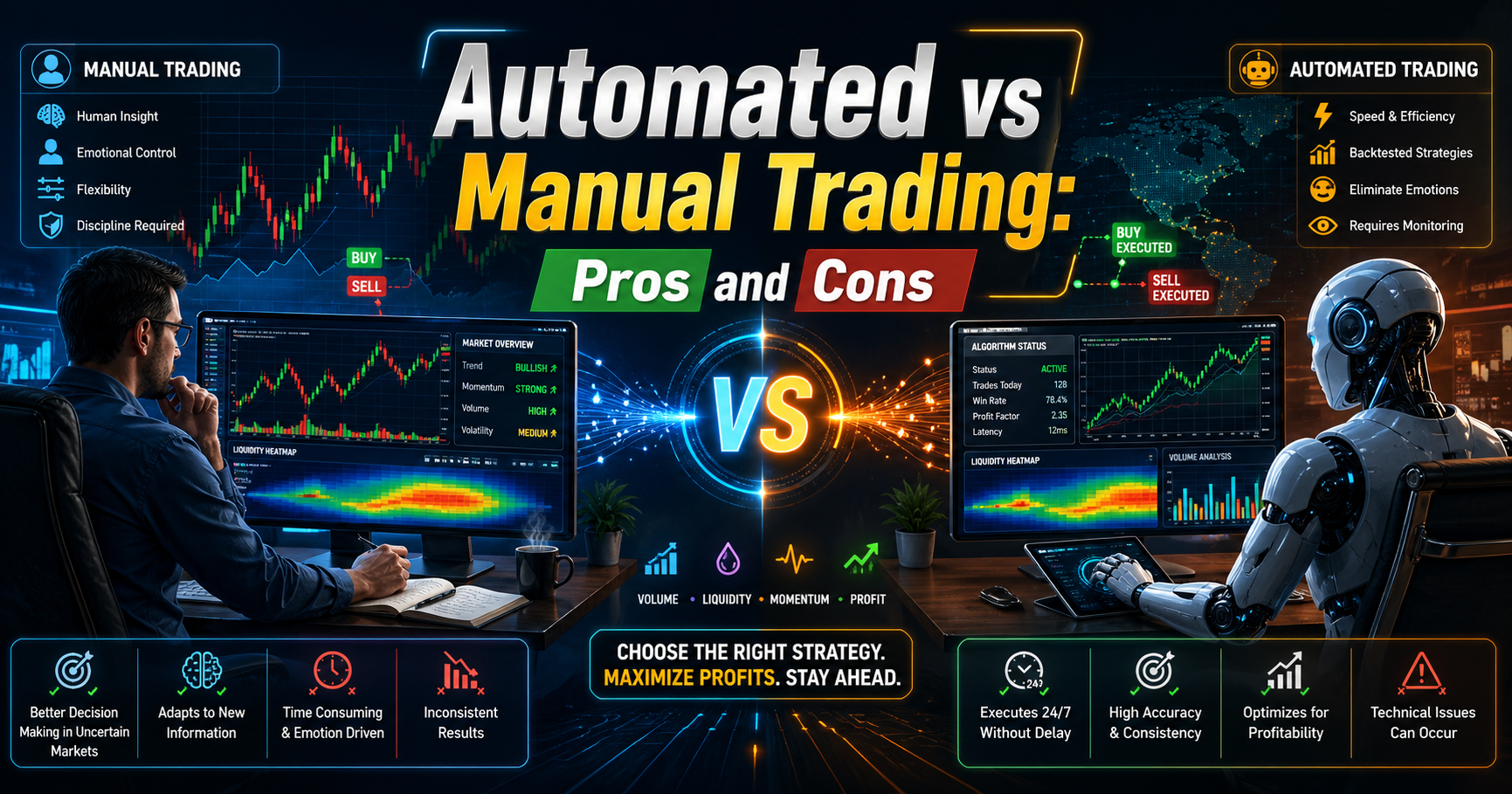
1. Introduction: Understanding Trading Approaches in Market Traffic
At Traffic Domination, trading success is built on a simple but powerful formula:
- Traffic = Market Volume, Liquidity, Momentum
- Domination = Strategy, Control, Profit Optimization
This concept defines how professional traders approach the markets. Traffic represents the movement and activity within the market—how much is being traded (volume), how easily assets can be bought or sold (liquidity), and the strength of price movement (momentum). Domination, on the other hand, is about how effectively a trader responds to that traffic using the right strategy, maintaining control, and maximizing profits.
In today’s fast-evolving financial markets, traders face a critical decision:
- Should they trade manually with full control over every decision?
- Or should they use automated trading systems to gain speed, efficiency, and consistency?
This choice is more than just a preference—it directly impacts how traders interact with market traffic and how well they can execute their strategies.
Manual Trading: Human Control Over the Market
Manual trading involves making decisions based on personal analysis, experience, and intuition. Traders observe charts, analyze volume and liquidity zones, and interpret momentum shifts before executing trades themselves.
This approach gives traders:
- Full control over every action
- Flexibility to adapt to sudden market changes
- The ability to interpret complex market behavior beyond rigid rules
However, it also requires constant attention, discipline, and emotional control.
Automated Trading: Algorithmic Execution and Speed
Automated trading uses algorithms, bots, or expert advisors to execute trades based on predefined rules. These systems scan the market, identify opportunities, and place trades automatically—often in milliseconds.
This approach offers:
- High-speed execution
- Emotion-free decision-making
- The ability to monitor multiple markets 24/7
But it relies heavily on pre-built logic and may struggle in unpredictable market conditions.
2. What is Manual Trading? (Human Control Over Market Traffic)
Manual trading is the traditional approach to trading where a human trader makes all decisions based on personal analysis, experience, and intuition. Unlike automated trading systems, every action—from analyzing the market to executing trades—is done manually by the trader. This approach puts full control in the hands of the individual, allowing for a highly customized trading experience.
How Manual Trading Works
In manual trading, traders carefully study the market before making decisions. Key tasks include:
- Analyzing Charts:
Traders examine price charts to identify trends, support and resistance levels, and key patterns that indicate potential opportunities. - Monitoring Market Traffic:
- Volume: How many units of an asset are being traded—helps determine market strength.
- Liquidity: How easily assets can be bought or sold without affecting price.
- Momentum: The speed and direction of price movement, signaling the market’s strength.
- Executing Trades Manually:
After analysis, the trader decides when and how to enter or exit a position. Every decision is based on the trader’s assessment of market conditions, rather than pre-programmed rules.
3. What is Automated Trading? (Algorithmic Domination of Markets)
Automated trading is a modern approach where trading decisions and execution are handled by technology—such as bots, algorithms, or Expert Advisors (EAs)—instead of a human manually placing trades. This method relies on predefined rules and logic that dictate when to enter, exit, or manage trades, allowing traders to interact with market traffic in a fast, consistent, and disciplined way.
Automated trading is often referred to as algorithmic trading, because it uses mathematical models and coded strategies to analyze market conditions and execute trades without human intervention.
How Automated Trading Works
Automated trading systems operate in a few key steps:
- Rule-Based Decision Making:
Traders set the rules or strategy parameters—such as indicators, stop-loss levels, or volume thresholds. The system then automatically follows these rules to execute trades. - Data Analysis:
Bots continuously monitor market traffic:- Volume: Detecting high activity zones to capitalize on liquidity
- Liquidity: Ensuring trades can be executed efficiently
- Momentum: Identifying trending moves or reversals
- Execution Without Human Intervention:
Once the conditions are met, the system executes trades in milliseconds. This eliminates emotional decisions and ensures consistency with the strategy.
4. Pros of Manual Trading (Strategy & Control Advantage)
Manual trading offers unique advantages that align directly with Domination = Control + Strategy. By actively managing trades and interpreting market traffic—Volume, Liquidity, and Momentum—traders gain complete command over their decisions. Unlike automated trading systems, manual trading allows for flexibility, intuition, and skill development that can significantly improve long-term market domination.
✔ Flexibility and Adaptability
One of the biggest strengths of manual trading is the ability to adapt to changing market conditions in real time.
- Traders can adjust strategies on the fly when market traffic shifts unexpectedly.
- Sudden news, geopolitical events, or major economic announcements can cause sharp changes in volume or momentum, and manual traders can respond immediately.
- Unlike rigid algorithms, humans can recognize patterns that deviate from standard signals, allowing for smarter, timely decisions.
Example: If a major earnings report causes unexpected volatility, a manual trader can delay or modify trade entries to avoid unnecessary risk, something an automated trading system may not handle well.
✔ Human Intuition
Humans possess the ability to read the market beyond the numbers, something algorithms cannot replicate fully.
- Manual traders can understand subtle price actions, like fake breakouts, liquidity traps, or unusual volume spikes.
- They can interpret market sentiment and anticipate potential reversals by combining technical analysis with real-world insights.
Example: Identifying a false breakout at a key resistance level allows a manual trader to avoid losses and wait for a more favorable opportunity.
✔ Learning and Skill Development
Manual trading is a powerful way to build expertise in market traffic.
- By analyzing charts, monitoring liquidity zones, and studying momentum shifts, traders deepen their understanding of how markets operate.
- Over time, this develops sharper decision-making skills, improving strategic execution in all trading conditions.
- Every trade becomes a learning opportunity, strengthening the trader’s ability to dominate markets with strategy and control.
Example: Experiencing firsthand how momentum accelerates during high-volume sessions teaches traders to anticipate moves rather than react passively.
✔ Full Control
Perhaps the most important advantage is complete authority over trade decisions.
- Traders decide exactly when to enter, exit, or stay out of the market.
- This control allows for better risk management and strategy customization.
- Unlike automated trading, where rules are fixed and cannot adapt, manual trading gives the trader the power to adjust every aspect of execution based on traffic conditions.
Example: A manual trader can choose to skip a trade entirely if liquidity is too low, reducing exposure to unpredictable price swings.
TradingView Tutorial for Forex and Crypto Traders
5. Cons of Manual Trading (Limitations in Speed & Emotion)
While manual trading offers control, flexibility, and strategic advantage, it also comes with significant drawbacks that can limit performance—especially in fast-moving, high-volume markets. Understanding these limitations is crucial for traders who want to dominate market traffic (Volume, Liquidity, Momentum) while maintaining strategy, control, and profit optimization.
❌ Emotional Trading
Human emotions—such as fear, greed, and hesitation—can significantly impact trading decisions.
- Fear may cause a trader to exit early, missing potential profits.
- Greed can lead to holding positions too long or over-leveraging, increasing risk.
- Hesitation can result in missed opportunities during high-momentum moves.
Example: A trader might see a sudden price spike and hesitate to enter, only to watch the opportunity vanish within seconds.
⚡ Impact: Emotional decisions reduce consistency and can erode the strategic advantage that manual trading otherwise provides.
❌ Time-Consuming
Manual trading requires constant attention to charts, indicators, and market news.
- Traders must monitor volume spikes, liquidity shifts, and momentum changes in real time.
- Missing even a short window of market activity can lead to suboptimal entries or exits.
Example: During high-volatility sessions, a trader might spend hours analyzing the market and still miss a key move due to the sheer speed of price changes.
⚡ Impact: The time commitment can be exhausting and may prevent traders from scaling their strategy across multiple markets effectively.
❌ Slow Execution
Manual traders cannot match the speed of automated trading systems.
- Every decision must be analyzed, confirmed, and executed manually.
- In fast-moving markets, even a delay of a few seconds can mean the difference between profit and loss.
Example: A sudden liquidity surge may create an ideal entry point for a trade, but by the time a manual trader reacts, the price may have moved beyond the optimal level.
⚡ Impact: Slower execution can result in missed opportunities and lower profit optimization compared to algorithmic trading.
❌ Inconsistency
Maintaining discipline with a manual strategy is challenging.
- Traders may deviate from their plan due to emotions or fatigue.
- It is difficult to follow a trading system strictly without error.
Example: A trader might ignore a stop-loss level because of overconfidence, leading to larger losses than planned.
⚡ Impact: Inconsistent execution reduces control over trades and undermines long-term market domination.
6. Pros of Automated Trading (Speed & Profit Optimization)
Automated trading is designed to give traders a competitive edge in today’s fast-paced markets. By focusing on Domination = Profit Optimization + Efficiency, automated trading systems allow traders to execute strategies with precision, discipline, and speed—capitalizing on market traffic (Volume, Liquidity, Momentum) that would be impossible to manage manually.
✔ Emotion-Free Trading
One of the biggest advantages of automation is the elimination of human emotions from trading decisions.
- Algorithms execute trades strictly based on pre-defined rules.
- Emotions like fear, greed, or hesitation do not interfere with entries, exits, or position sizing.
- This ensures consistent execution, which is key for long-term profit optimization.
Example: During high-volatility periods, a human trader might panic and exit a profitable trade early, while an automated trading system will follow its logic and maximize gains.
⚡ Impact: Emotion-free trading strengthens control over outcomes, ensuring your strategy performs consistently across all market conditions.
✔ High-Speed Execution
Automated trading systems operate in milliseconds, far faster than any human can react.
- They can instantly analyze market traffic—including spikes in volume, liquidity changes, and momentum shifts—and act on opportunities immediately.
- This speed allows traders to capture price movements before they disappear, improving efficiency and profitability.
Example: A bot can execute a scalp trade on a liquidity surge the moment it appears, capturing micro-movements that a manual trader would likely miss.
⚡ Impact: High-speed execution ensures traders never miss optimal entry or exit points, a critical advantage in volatile markets.
✔ Backtesting & Optimization
Automated trading allows strategies to be tested and refined using historical data before risking real capital.
- Traders can simulate how a strategy would have performed under various market conditions.
- This reduces guesswork and improves confidence in the strategy’s effectiveness.
- Backtesting also highlights potential weaknesses, allowing for strategy optimization to maximize profit.
Example: Before deploying a momentum-based strategy live, a trader can backtest it on past high-volume sessions to ensure it consistently captures profitable trends.
⚡ Impact: Backtesting increases efficiency, reduces risk, and enhances profit optimization.
✔ 24/7 Market Monitoring
Automated systems never sleep.
- They continuously scan multiple markets for opportunities, even when the trader is offline.
- This is especially valuable in Forex, cryptocurrency, and global equity markets that operate across time zones.
Example: A bot can monitor liquidity spikes during off-hours and enter trades automatically, ensuring no opportunity is missed.
⚡ Impact: 24/7 monitoring maximizes exposure to profitable market traffic and ensures consistent strategy execution.
✔ Multi-Market Trading
Automation enables traders to handle multiple assets simultaneously, something manual trading cannot achieve efficiently.
- Bots can manage dozens of trades across Forex pairs, stocks, commodities, or crypto at the same time.
- This diversification increases potential profits while spreading risk across different market traffic sources.
Example: A single automated system can simultaneously execute trades in EUR/USD, BTC/USD, and gold futures, responding instantly to changes in volume, liquidity, or momentum.
⚡ Impact: Multi-market capability improves efficiency, control, and profit optimization, all critical elements of domination.
7. Cons of Automated Trading (Control & Flexibility Risks)
While automated trading offers speed, efficiency, and profit optimization, it also comes with notable drawbacks. Traders must understand these limitations to ensure they maintain strategy, control, and market domination, even when relying on technology.
❌ Lack of Adaptability
Automated systems follow predefined rules, which makes them less flexible in unexpected market conditions.
- Sudden news events, economic announcements, or geopolitical shocks can drastically affect market traffic (Volume, Liquidity, Momentum).
- Bots cannot interpret context or sentiment—they will execute trades based on existing rules, even if market conditions are abnormal.
Example: During an unexpected central bank announcement, an automated system may enter trades according to its programmed strategy, ignoring volatility spikes that a manual trader would avoid.
⚡ Impact: Lack of adaptability can lead to losses during unpredictable events, reducing overall control and domination.
❌ Technical Risks
Automated trading depends entirely on technology and infrastructure, which introduces technical vulnerabilities.
- System crashes, internet outages, or software bugs can prevent trades from executing properly.
- Even minor glitches in code can result in significant losses, especially in high-frequency or large-volume trading.
Example: A bot might fail to close a trade at the programmed stop-loss due to connectivity issues, exposing the trader to larger losses than intended.
⚡ Impact: Traders must constantly monitor their systems and have contingency plans, which can reduce the time-saving advantage of automation.
❌ Over-Optimization (Curve Fitting)
Backtested strategies can sometimes be over-optimized to perform well on historical data, but fail in real market conditions.
- Bots may be designed to exploit patterns that existed in the past but are no longer relevant.
- Market traffic is dynamic—Volume, Liquidity, and Momentum shift constantly—and over-optimized strategies may underperform in live trading.
Example: A strategy tuned to perform perfectly during high-volatility sessions may lose money during low-volatility periods.
⚡ Impact: Over-optimization can erode profit potential and reduce strategic control over trades.
❌ High Setup Cost
Automated trading often requires advanced skills or financial investment.
- Developing or purchasing reliable bots can be expensive.
- Traders may need programming knowledge or access to premium platforms and APIs.
- Continuous monitoring and updates are often necessary to keep the system effective.
Example: Hiring a developer to code a custom trading bot can cost hundreds or thousands of dollars, plus ongoing maintenance costs.
⚡ Impact: High setup cost can be a barrier for beginner traders or those with limited capital, potentially delaying their path to market domination.
8. Automated vs Manual Trading: Key Differences
Understanding the differences between automated and manual trading is essential for any trader aiming to dominate markets. At Traffic Domination, we evaluate trading methods through the lens of our core formula:
- Traffic = Market Volume, Liquidity, Momentum
- Domination = Strategy, Control, Profit Optimization
Both approaches interact with market traffic differently and offer distinct advantages and challenges. Below is a detailed comparison.
🔥 Traffic Handling
Automated Trading:
- Processes vast amounts of market data instantly.
- Can track multiple instruments, liquidity pools, and high-volume zones simultaneously.
- Reacts to volume surges, liquidity gaps, and momentum shifts in milliseconds, capitalizing on opportunities that a human could miss.
Manual Trading:
- Focuses on interpreting deeper market context.
- Humans can analyze subtle patterns, hidden liquidity, and sentiment-driven moves.
- Allows for nuanced decisions that automated systems may overlook, such as spotting fake breakouts or low-probability reversals.
Insight: Automated systems excel at handling traffic at scale, while manual trading thrives in interpretation of complex patterns.
⚡ Execution Speed
Automated Trading:
- Executes trades in milliseconds, faster than any human.
- Captures opportunities during high-momentum periods and volatile market conditions.
- Ensures precise timing for entries, exits, and risk management rules.
Manual Trading:
- Execution is slower because each decision is analyzed and confirmed by the trader.
- Trades may be missed during sudden spikes in volume or rapid price moves.
- Slower execution allows for careful thought but may sacrifice some opportunities in fast-moving markets.
Insight: Speed is the main advantage of automation, while thoughtful manual execution offers precision and context-based judgment.
🧠 Strategy Control
Automated Trading:
- Operates on fixed rules and algorithms.
- Consistently applies strategies exactly as coded, ensuring discipline.
- Limited flexibility to adjust to unexpected market events.
Manual Trading:
- Offers flexible decision-making.
- Traders can adapt strategies in real time based on new market information or changes in momentum and liquidity.
- Requires skill, knowledge, and emotional discipline to execute effectively.
Insight: Automation enforces consistency, but manual trading gives full control over strategy adaptation.
💰 Profit Optimization
Automated Trading:
- Provides consistent execution, reducing human errors.
- Capitalizes on repetitive opportunities across multiple markets.
- Enhances profit optimization through speed, discipline, and round-the-clock market coverage.
Manual Trading:
- Profit depends heavily on the trader’s discipline, timing, and skill.
- Success can vary based on emotional control and market interpretation.
- Offers potential for higher profits in complex scenarios but with higher risk.
Insight: Automation ensures steady profit optimization, while manual trading can yield higher gains in skilled hands but is less predictable.
9. Hybrid Trading: The Ultimate Traffic Domination Strategy
For traders seeking true market domination, the answer is not choosing between manual or automated trading—it’s combining the strengths of both. At Traffic Domination, we define success as mastering:
- Traffic = Market Volume, Liquidity, Momentum
- Domination = Strategy, Control, Profit Optimization
A hybrid trading approach allows traders to leverage automation for efficiency while keeping human insight for strategic control, creating a system that maximizes both opportunity and profitability.
Why Hybrid Trading Works
Neither manual nor automated trading alone is perfect:
- Manual trading provides flexibility, intuition, and adaptive control, but it’s slow and prone to emotion.
- Automated trading offers speed, consistency, and 24/7 monitoring, but it lacks adaptability and human judgment.
By combining the two, traders gain the best of both worlds: speed and efficiency from automation, and strategy and control from manual oversight. This ensures domination over market traffic while optimizing profit potential.
How to Implement Hybrid Trading
Use Automation for:
- Execution – Let bots place trades instantly based on predefined rules, capturing high-speed opportunities in volatile markets.
- Data Scanning – Algorithms can monitor multiple markets, track volume spikes, liquidity gaps, and momentum shifts, providing insights that a human might miss.
- Trade Management – Automated systems can manage stop-losses, take-profits, and scaling positions, ensuring consistent risk control.
Example: A bot identifies a momentum breakout in EUR/USD and executes the trade immediately while managing stop-loss and profit targets automatically.
Use Manual Trading for:
- Strategy Decisions – Humans can analyze market context, interpret patterns, and decide which signals to act on, adding flexibility to the automated system.
- Market Interpretation – Evaluate unusual events, news, or low-liquidity periods that might confuse an algorithm.
- Risk Management – Adjust positions or pause automation when market traffic behaves unusually, protecting capital and ensuring discipline.
Example: A trader notices sudden volatility due to geopolitical news and decides to temporarily suspend automated trades to avoid unnecessary exposure.
10. Conclusion: Which One Leads to True Market Domination?
After exploring the pros and cons of manual and automated trading, it’s clear that there isn’t a one-size-fits-all solution. At Traffic Domination, we define trading mastery through our core formula:
- Traffic = Market Volume, Liquidity, Momentum
- Domination = Strategy, Control, Profit Optimization
The key is understanding how each approach interacts with market traffic and leveraging their strengths to maximize domination.
Manual Trading = Strategy + Control
Manual trading gives traders the flexibility to adapt, the intuition to read complex market behavior, and full control over every trade. It is ideal for:
- Adjusting to unpredictable market events
- Interpreting patterns and sentiment
- Applying personalized strategies with discretion
Benefit: By managing traffic actively, traders maintain control over strategy and can respond to subtle shifts in volume, liquidity, and momentum.
Automated Trading = Speed + Profit Optimization
Automated trading provides fast, precise execution and the ability to process large amounts of market data. It is ideal for:
- Capturing opportunities instantly in volatile markets
- Monitoring multiple markets and instruments simultaneously
- Executing a strategy consistently without emotional interference
Benefit: Automation ensures that traders can optimize profits efficiently, capitalizing on every trading opportunity that arises from market traffic.
✅ The True Path to Success
True market domination does not come from choosing one approach over the other. Success is achieved by:
- Understanding market traffic – Analyzing Volume, Liquidity, and Momentum to identify opportunities.
- Applying the right mix of strategy, control, and automation – Using manual insight to guide decisions while leveraging automation for speed, consistency, and efficiency.
🚀 Final Takeaway
“Domination is not about choosing manual or automated trading — it’s about mastering both.”
By combining human judgment with algorithmic precision, traders can:
- Capture opportunities faster than the market moves
- Maintain control over strategy and risk
- Optimize profits across all market conditions
In the world of trading, those who master both approaches—using manual trading for insight and automated systems for execution—will consistently turn market traffic into domination, achieving long-term success in Volume, Liquidity, and Momentum.