
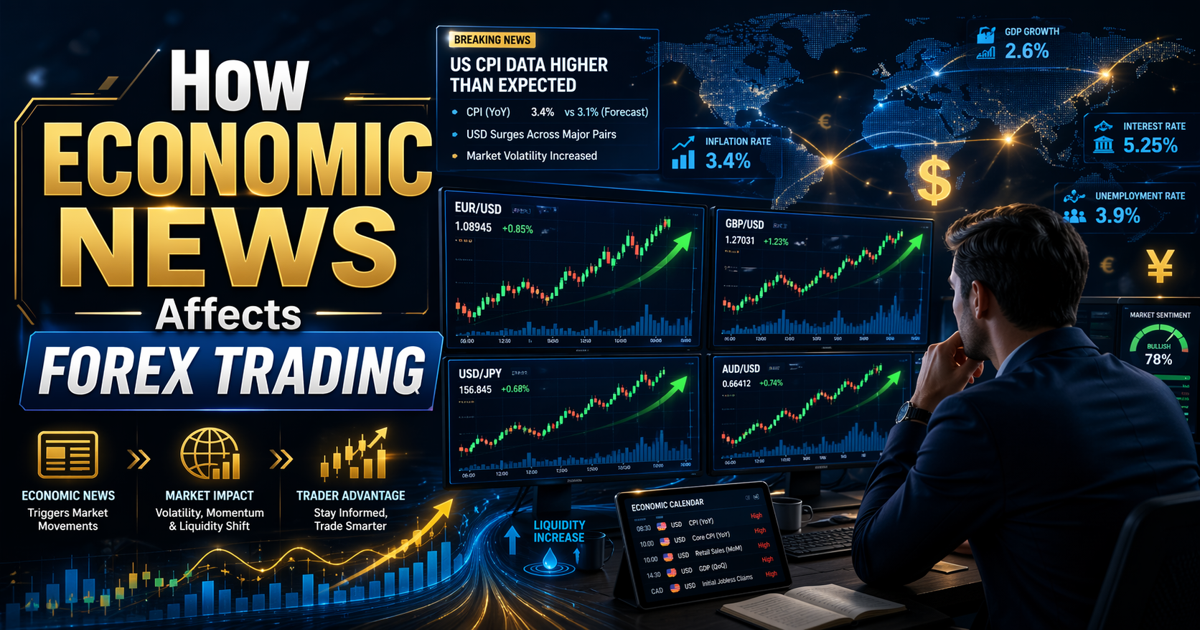
1. Introduction: Why Economic News Matters in Forex
Forex trading is not just about buying and selling currencies; it’s a dynamic, fast-paced market where every second counts. The movement of currency prices is primarily driven by market traffic factors:
- Volume – The number of trades happening in a particular currency pair at any given moment.
- Liquidity – How easily traders can enter or exit positions without affecting the price.
- Momentum – The speed and strength of price movement in response to market forces.
These traffic factors are directly influenced by economic news, making it one of the most powerful tools for traders who want to dominate the Forex market.
Economic indicators such as interest rate decisions, GDP growth reports, unemployment data, inflation figures, and trade balances can create sudden spikes in volume and liquidity, while also fueling rapid momentum. For example:
- A higher-than-expected inflation report might trigger a surge in volume as traders react to anticipated central bank rate hikes.
- A disappointing GDP report can slow momentum in a currency pair, reducing liquidity temporarily as traders pause to reassess.
Understanding these reactions is crucial. Traders who can interpret economic news and anticipate market traffic gain a distinct advantage—they can position themselves strategically, maintain control over trades, and optimize profits.
The ultimate goal is domination in Forex trading: not simply reacting to news, but using it to shape strategy, manage control, and consistently optimize profits. By mastering the impact of economic news, you can transform unpredictable market events into opportunities for traffic exploitation and strategic dominance.
In this guide, we will explore how economic news moves the market, how to analyze traffic factors like volume, liquidity, and momentum, and how to implement strategies that turn economic news into a consistent profit optimization tool.
2. Understanding Market Traffic: Volume, Liquidity, and Momentum
In Forex trading, “traffic” refers to the overall activity in the market that drives price movement. Just like traffic on a highway indicates how busy the road is, market traffic shows how active a currency pair is. For traders focused on domination—strategy, control, and profit optimization—understanding traffic is essential. The three main components of market traffic are volume, liquidity, and momentum.
Volume: The Pulse of the Market
Volume represents the number of trades executed in a particular currency pair during a specific period.
- High trading volume usually occurs during major economic news releases, such as interest rate announcements or employment reports.
- Tracking volume allows traders to anticipate the intensity of market reactions.
- Example: When the Non-Farm Payroll (NFP) report is released, the USD often experiences a sudden spike in volume. Traders who monitor this can identify opportunities for strategic entries before momentum fully develops.
Liquidity: How Smoothly You Can Move
Liquidity refers to the ease with which traders can enter or exit positions without causing large price swings.
- During periods of high liquidity, trades can be executed quickly and at predictable prices.
- Low liquidity, often seen outside major trading sessions or during unexpected economic news, can lead to slippage and erratic price movements.
- Understanding liquidity helps traders control risk, ensuring that their strategy doesn’t fail due to unpredictable market behavior.
Momentum: The Speed and Strength of Movement
Momentum measures the speed and direction of price movements.
- Strong momentum often follows high-volume news, leading to rapid price shifts.
- Momentum allows traders to capitalize on short-term trends, making it a critical component of traffic-based strategies.
- Example: A positive GDP surprise may trigger strong upward momentum in a country’s currency, creating opportunities for profit optimization through well-timed entries and exits.
Why Tracking Traffic Matters
By monitoring volume, liquidity, and momentum together, traders can:
- Anticipate the market’s reaction to economic news.
- Determine the optimal timing for entry and exit points.
- Maintain control over positions, reducing risk in volatile markets.
- Execute strategies that maximize profit potential in high-traffic scenarios.
Practical Example
Imagine the Federal Reserve announces an unexpected interest rate hike. Here’s how traffic unfolds:
- Volume surges as traders quickly adjust positions.
- Liquidity may temporarily tighten due to rapid buying and selling.
- Momentum drives the currency sharply higher, creating a window for strategic traders to enter trades and optimize profits.
Understanding market traffic is the first step to dominating Forex trading. It allows you to move from simply reacting to economic news to anticipating price behavior, executing with strategy, and optimizing profits consistently.
3. Key Economic Indicators and Their Impact
In Forex trading, understanding key economic indicators is crucial because these reports are the primary drivers of market traffic—volume, liquidity, and momentum. Traders who can interpret these indicators can anticipate price movements, maintain control, and execute strategies that lead to consistent profit optimization.
Below are the most influential economic reports and how they impact Forex markets:
1. Interest Rates (Central Bank Announcements)
- Central banks, such as the Federal Reserve, European Central Bank, and Bank of England, use interest rate decisions to influence inflation and economic growth.
- Impact on market traffic:
- Volume spikes as traders adjust positions based on expected returns.
- Liquidity often increases as major players enter the market.
- Momentum can surge in either direction depending on the nature of the announcement.
- Example: An unexpected rate hike by the Fed can sharply strengthen the USD as traders buy in anticipation of higher returns, creating high traffic conditions perfect for strategic entries.
2. Employment Data (Non-Farm Payrolls & Unemployment Rate)
- Employment reports reflect the health of a country’s labor market and overall economic stability.
- Impact on market traffic:
- Volume rises significantly during releases like the U.S. Non-Farm Payrolls (NFP).
- Liquidity may temporarily tighten due to rapid market reactions.
- Momentum can create short-term trends or reversals depending on whether the data beats or misses expectations.
- Example: Stronger-than-expected NFP results can create upward momentum for the USD, giving traders an opportunity to optimize profits with precise entries.
3. GDP Growth Reports
- Gross Domestic Product (GDP) measures the overall economic output of a country.
- Impact on market traffic:
- A strong GDP report often increases volume as traders anticipate central bank actions.
- Momentum builds in currencies of countries showing robust growth.
- Traders can use these surges to execute strategies with control, riding trends efficiently.
- Example: A country reporting accelerating GDP growth may attract foreign investment, strengthening its currency and increasing liquidity.
4. Inflation Indicators (CPI, PPI)
- Consumer Price Index (CPI) and Producer Price Index (PPI) indicate inflation trends.
- Impact on market traffic:
- Inflation above targets can trigger expectations of interest rate hikes, boosting volume.
- Momentum often spikes quickly as traders react to news.
- Understanding inflation allows traders to maintain control over positions during volatile conditions.
- Example: Rising CPI can lead to aggressive buying in a currency pair, creating an ideal environment for profit optimization with disciplined entries and exits.
5. Trade Balance & Consumer Sentiment
- Trade balance reports show the difference between imports and exports, while consumer sentiment reflects confidence in the economy.
- Impact on market traffic:
- Positive trade balances or strong consumer confidence reports increase liquidity, as market participants feel more confident trading the currency.
- Momentum may build gradually, allowing strategic traders to position themselves before larger moves occur.
- Example: An improving trade balance often strengthens a country’s currency over time, giving traders opportunities to plan medium-term strategies with traffic awareness.
4. Timing News Releases and Volatility
In Forex trading, understanding when to trade around economic news is just as important as knowing what to trade. Timing can determine whether a trader capitalizes on market traffic—volume, liquidity, momentum—or gets caught in unpredictable swings.
The Power of Timing: Predictable Spikes in Traffic
Major economic news releases, such as interest rate decisions, GDP reports, or employment data, often create predictable surges in market traffic:
- Volume spikes as traders rush to enter or exit positions.
- Momentum accelerates in the direction favored by the economic news.
- Liquidity may temporarily tighten or expand depending on market reaction.
By anticipating these traffic surges, traders can position themselves to maximize strategy and profit optimization. For example:
- Entering a trade just before a scheduled high-impact report can yield strong momentum-driven gains.
- Conversely, trading blindly during unpredictable spikes without control may lead to losses.
Trading Sessions and Their Impact on Liquidity
Forex is a 24-hour market divided into three major sessions:
- Tokyo Session (Asian Market)
- Moderate liquidity; best for trading JPY and other Asian currencies.
- Volume and momentum are generally lower compared to London or New York.
- London Session (European Market)
- High liquidity as the European market overlaps with Asia and early U.S. sessions.
- Major currency pairs like EUR/USD, GBP/USD see strong volume and momentum.
- New York Session (U.S. Market)
- Often sees the highest liquidity and volume due to U.S. economic news releases.
- Momentum spikes are common, particularly during overlapping hours with London.
Understanding these sessions allows traders to align trades with periods of optimal traffic, ensuring that liquidity supports entries and exits and reducing the risk of slippage or erratic price moves.
Managing Risk During High Volatility
High-impact economic news often leads to rapid price swings. While this creates profit opportunities, it also increases risk. Traders must exercise control and strategic execution to optimize gains:
- Use stop-losses to protect positions against sudden reversals.
- Adjust position sizes during volatile periods to manage risk.
- Avoid overtrading, focusing only on trades that fit your strategy.
Example: If the U.S. releases a stronger-than-expected CPI report during the New York session:
- Volume surges as traders react.
- Momentum drives USD pairs sharply.
- Traders using control and a pre-planned strategy can enter at ideal levels, capture profits, and exit without emotional mistakes.
5. Trading Strategies Around Economic News
Trading Forex around economic news requires more than reacting to sudden price movements—it demands strategy, control, and an understanding of market traffic. By leveraging volume, liquidity, and momentum, traders can position themselves for consistent profit optimization. Below are the key strategies tailored for traffic and domination principles:
1. Pre-News Positioning: Anticipating Momentum
- Pre-news positioning involves entering trades before a major economic report based on predictions of market reaction.
- This strategy relies on:
- Analyzing past reactions to similar news events.
- Understanding current market traffic (volume, liquidity, momentum).
- Traffic Insight: Anticipating a spike in volume allows traders to position themselves to ride the momentum immediately after the release.
- Domination Principle: By carefully planning entries and exits, you maintain control over risk while maximizing the potential for profit optimization.
- Example: A trader expects the Non-Farm Payrolls (NFP) report to be stronger than consensus. They position themselves on the USD ahead of the release, ready to capture momentum as the news hits.
2. Breakout Trading: Leveraging Liquidity Surges
- Breakout trading focuses on entering trades when prices move beyond key support or resistance levels during high-volume events.
- Traffic Insight: News releases often create sudden surges in liquidity, enabling rapid price movement across established levels.
- Domination Principle: Successful breakouts require precise strategy and control, as false breakouts can quickly reverse.
- Example: If the European Central Bank announces an unexpected rate change, EUR/USD might break a resistance level with high volume. A trader following breakout rules can capitalize on the surge before momentum slows.
3. Fade Trading: Capitalizing on Overreactions
- Fade trading is the practice of trading against extreme market reactions after a news event, assuming the initial spike may overextend.
- Traffic Insight: Large volume and momentum spikes often lead to temporary overreactions.
- Domination Principle: This strategy requires careful control and risk management to avoid getting caught in prolonged trends.
- Example: After a surprising GDP report, a currency may initially spike 100 pips in one direction. Fade traders wait for signs of exhaustion, then enter in the opposite direction, exploiting short-term volatility.
Strategy + Control = Profit Optimization
- All these strategies depend on the core principle of Traffic Domination:
- Traffic: Understand and anticipate volume, liquidity, and momentum.
- Domination: Apply strategy with control to consistently optimize profits.
- The combination ensures that trades are not reactive, but calculated, with risk managed even during high-volatility news events.
Real-World Tip
- Use an economic calendar to plan trades in advance.
- Identify high-impact news events.
- Avoid overexposing your positions by limiting trade size during unpredictable spikes.
- This simple step ensures you are prepared to exploit traffic patterns while maintaining control, increasing your chance of consistent profit optimization.
Candlestick Patterns Every Trader Should Know
6. Interpreting Market Reactions
When economic news is released, the Forex market reacts almost instantly. Prices can move within seconds as traders, institutions, and algorithms respond to new information. However, not every market reaction leads to a clear trend. To dominate Forex trading, traders must learn how to interpret post-news price behavior by analyzing volume, liquidity, and momentum—the core elements of market traffic.
Understanding these reactions allows traders to maintain control, avoid false signals, and execute strategies that lead to consistent profit optimization.
Sudden Spikes vs. Gradual Trends
One of the first things traders notice after a major news release is a sudden price spike. This happens when a large number of traders react simultaneously to unexpected economic data.
- Sudden spikes usually occur within seconds of the news announcement.
- These spikes are often driven by algorithmic trading and institutional orders, which can create sharp price movements in a very short time.
- While these moves can offer quick profit opportunities, they can also reverse quickly.
In contrast, some news events create gradual trends rather than instant spikes. This happens when the market slowly absorbs the information and traders build positions over time.
For example:
- A surprise interest rate hike may cause an immediate spike in a currency pair.
- However, if the economic outlook remains strong, the currency may continue trending in the same direction for hours or even days.
Understanding the difference between a temporary spike and a sustained trend helps traders decide whether to enter immediately or wait for confirmation before executing a strategy.
Correlating Volume with Momentum
Volume and momentum often move together after major economic news. Learning to correlate these two factors is key to understanding whether a price movement is strong and sustainable.
- High volume + strong momentum usually indicates a powerful move supported by many market participants.
- Low volume + sharp movement can signal instability or manipulation, increasing the risk of reversals.
For example, if a positive employment report triggers strong buying in a currency pair:
- A large surge in trading volume confirms strong interest from traders.
- Momentum accelerates, pushing prices higher as more participants join the move.
In this scenario, traders can use traffic analysis to enter the market confidently, knowing the movement is supported by real liquidity and participation.
However, if momentum appears without strong volume, the move may weaken quickly. Recognizing this difference helps traders maintain control and avoid risky entries.
Spotting Fakeouts (False Signals)
Not every price movement after economic news reflects the true direction of the market. Sometimes the initial reaction is misleading, creating what traders call a fakeout or false signal.
A fakeout occurs when:
- Price breaks a key support or resistance level.
- Traders enter expecting a strong trend.
- The market quickly reverses, trapping traders in losing positions.
Fakeouts often happen because:
- Early reactions are driven by emotion or algorithmic trading.
- Liquidity temporarily disappears during high volatility.
- The market reassesses the news after the initial reaction.
For example, a currency pair may break above a resistance level immediately after a GDP announcement. Traders might rush to buy, expecting continued momentum. But if the market later interprets the report differently, price may reverse sharply, trapping those early buyers.
To avoid fakeouts, traders should:
- Wait for confirmation from volume and momentum before entering trades.
- Observe whether price holds above or below key levels after the initial spike.
- Maintain discipline and strategic control, rather than reacting emotionally to fast-moving markets.
7. Risk Management During News Events
Economic news releases can create some of the most volatile conditions in the Forex market. While these events generate strong opportunities through **market traffic—volume, liquidity, and momentum—**they also carry significant risk. Sudden price swings, rapid reversals, and unpredictable spikes can quickly turn profitable trades into losses if traders fail to maintain proper control.
For traders who aim for market domination through strategy and profit optimization, risk management during news events is essential. The key is not just identifying opportunities but also protecting capital while navigating high volatility.
Maintaining Control Over Emotions and Positions
One of the biggest challenges during major news events is emotional decision-making. When prices move rapidly, traders often feel pressured to act immediately, leading to impulsive trades.
Common emotional mistakes include:
- Entering trades without confirmation
- Increasing position sizes to chase fast-moving trends
- Ignoring stop-loss levels due to fear of missing out
Successful traders maintain discipline and strategic control, even when the market becomes extremely active. Instead of reacting emotionally, they rely on pre-planned strategies based on traffic analysis—volume, liquidity, and momentum—to guide their decisions.
Maintaining control allows traders to stay focused on long-term profit optimization, rather than short-term excitement.
Setting Stop-Losses Based on Volatility
During economic news releases, price movements can expand dramatically. Standard stop-loss distances that work during normal market conditions may not be suitable when volatility increases.
A more effective approach is to adjust stop-loss levels based on volatility.
This means:
- Placing stop-losses further away during high-impact news events.
- Considering recent price swings and volatility indicators.
- Ensuring stops are not so tight that normal price fluctuations trigger premature exits.
For example, if a currency pair normally moves 20–30 pips in a short time but begins moving 60–80 pips during a news release, traders should adjust their stop placement accordingly. This allows trades to survive temporary fluctuations while still maintaining risk control.
Using volatility-based stop-losses helps traders protect their positions without interfering with momentum-driven opportunities.
Reducing Position Size During High-Traffic Events
High-impact economic announcements often lead to surges in market traffic. While high volume and momentum can create strong trading opportunities, they also increase risk due to rapid price changes.
One of the most effective risk management techniques is reducing position size during these periods.
Smaller positions help traders:
- Manage risk during unpredictable price spikes.
- Maintain better control over their trades.
- Avoid large losses if the market moves unexpectedly.
For example, instead of risking a full trade size during a Non-Farm Payroll release, experienced traders may reduce their exposure while still participating in the market. This ensures that they can benefit from high momentum without overexposing their capital.
This approach aligns perfectly with the principle of domination through strategy and control.
Avoiding Trading During Extremely Low Liquidity Periods
While high traffic creates volatility, low liquidity can also be dangerous for traders. When liquidity drops significantly, even small trades can cause large price swings.
Low liquidity often occurs during:
- Late trading hours between major sessions
- Holidays when major financial markets are closed
- Periods immediately before major news announcements
During these times, traders may experience:
- Slippage (orders executing at worse prices)
- Wide spreads
- Erratic price movements
Instead of forcing trades in these conditions, disciplined traders focus on high-quality opportunities when liquidity and traffic are strong. This ensures smoother trade execution and more reliable market behavior.
8. Tools and Resources to Track Economic News
Successful Forex traders do not rely on guesswork. They depend on reliable tools and resources to monitor economic developments and understand how news influences market traffic—volume, liquidity, and momentum. Having access to accurate information in real time allows traders to anticipate volatility, plan strategies, and maintain control over their trades.
To achieve consistent profit optimization and market domination, traders must integrate the right tools into their daily trading routine. These resources help identify when economic events are likely to trigger significant market activity and how traders can position themselves strategically.
Below are some of the most important tools used by professional traders to track economic news and analyze market traffic.
Economic Calendars
An economic calendar is one of the most essential tools for Forex traders. It provides a schedule of upcoming economic events, including major announcements that may affect currency markets.
Economic calendars typically include information such as:
- Interest rate decisions by central banks
- Employment reports such as Non-Farm Payrolls
- Inflation data like Consumer Price Index (CPI)
- GDP growth reports
- Retail sales and manufacturing data
These events are often categorized by impact level, helping traders quickly identify which announcements are likely to create significant market traffic.
For example, a high-impact event such as a central bank rate decision can trigger:
- A surge in trading volume
- Increased liquidity
- Strong price momentum
By reviewing the economic calendar before trading each day, traders can prepare their strategy in advance rather than reacting emotionally when the news is released.
Real-Time News Feeds
Real-time financial news platforms are another crucial resource for traders who want to stay ahead of market developments. Services like Bloomberg and Reuters deliver instant updates on global economic events, political developments, and central bank commentary.
These platforms provide valuable insights such as:
- Breaking economic news
- Market analysis from financial experts
- Statements from policymakers
- Unexpected global events that may impact currencies
For example, if a central bank governor unexpectedly signals future interest rate changes, markets may react immediately—even before official economic data is released.
Traders who monitor reliable news feeds gain a competitive advantage, allowing them to interpret market sentiment and prepare for potential traffic spikes in currency pairs.
Volume and Liquidity Tracking Tools
Beyond news reports and calendars, traders also rely on technical tools that track market activity directly. These tools help analyze the traffic flowing through the market in real time.
Some commonly used indicators and platforms include:
- Volume indicators that show the level of trading activity in a currency pair
- Liquidity heatmaps that reveal where large orders may exist in the market
- Momentum indicators that measure the speed and strength of price movements
These tools allow traders to confirm whether a price movement is supported by strong participation or whether it might be a temporary spike caused by limited liquidity.
For instance, if economic news triggers a price breakout but volume remains weak, traders may suspect a false breakout or fakeout. However, if strong volume and momentum accompany the move, it indicates that the market traffic supports the trend.
9. Case Studies: Economic News Impact on Forex
To truly understand how economic news influences Forex markets, it helps to examine real-world scenarios. Major economic announcements often create powerful reactions in currency pairs by triggering market traffic—volume, liquidity, and momentum.
By studying these reactions, traders can learn how to prepare before the news, analyze market behavior after the release, and apply strategy and control for profit optimization.
Below are two common examples of how economic news events move the Forex market.
Case Study 1: Non-Farm Payroll (NFP) Report Causing USD Volatility
The Non-Farm Payroll (NFP) report is one of the most influential economic indicators in the Forex market. Released monthly in the United States, it measures the number of jobs added or lost in the economy. Because employment data reflects economic strength, it often triggers significant volatility in USD currency pairs.
Pre-News Positioning
Before the NFP report is released, traders closely analyze:
- Market expectations for job growth
- Previous employment data trends
- Overall economic sentiment
If analysts expect strong job growth, some traders may position themselves long on the USD before the announcement. However, experienced traders often remain cautious because unexpected data can cause sharp reversals.
Preparing ahead of time allows traders to develop a clear strategy rather than reacting emotionally once the news hits.
Post-News Traffic Analysis (Volume and Momentum)
When the NFP report is released, the market typically reacts within seconds.
For example, if the report shows higher-than-expected job growth:
- Trading volume surges as institutions and traders enter positions.
- Liquidity increases, enabling rapid price movement.
- Momentum drives USD pairs upward, sometimes by dozens of pips within minutes.
In contrast, a weaker-than-expected report may cause a rapid sell-off in the USD, creating strong downward momentum.
Traders analyzing market traffic can determine whether the move is supported by strong participation or if it may reverse shortly after the initial reaction.
Strategy and Control for Profit Optimization
Professional traders do not simply jump into trades during the initial spike. Instead, they:
- Wait for confirmation from volume and sustained momentum
- Identify key support or resistance levels
- Apply strict risk management controls
For example, a trader might wait for a short pullback after the initial spike before entering a momentum trade. This approach allows them to ride the trend while maintaining better control over risk.
By combining traffic analysis with disciplined strategy, traders can turn NFP volatility into an opportunity for profit optimization.
Case Study 2: European Central Bank (ECB) Rate Decisions Affecting EUR Pairs
Another powerful example of economic news impact is the interest rate decision from the European Central Bank (ECB). These announcements strongly influence the EUR and related currency pairs, such as EUR/USD and EUR/GBP.
Interest rates affect currency values because they determine the return investors receive for holding that currency.
Pre-News Positioning
Before an ECB rate decision, traders analyze several factors:
- Inflation trends in the Eurozone
- Economic growth forecasts
- Previous statements from ECB officials
If the market expects a rate hike, traders may anticipate a stronger euro and position themselves accordingly.
However, central bank announcements often include unexpected commentary or policy changes, which means traders must maintain flexibility in their strategy.
Post-News Traffic Analysis (Volume and Momentum)
Once the ECB announcement is released, EUR pairs often experience dramatic movement.
Typical reactions include:
- Sharp increases in trading volume as global investors adjust positions.
- Rapid changes in liquidity levels, especially during the European and U.S. trading sessions.
- Strong momentum in EUR pairs, depending on whether the decision meets or surprises market expectations.
For example, an unexpected rate hike may cause EUR/USD to surge quickly, while a dovish policy statement may trigger a rapid decline.
Traders analyzing traffic patterns can determine whether the move represents a sustainable trend or a temporary spike.
Strategy and Control for Profit Optimization
To take advantage of ECB announcements, disciplined traders follow a structured approach:
- Wait for the initial volatility to stabilize.
- Analyze whether volume and momentum confirm the direction of the move.
- Enter trades only when the market shows clear direction.
This method prevents traders from getting caught in false breakouts or fakeouts, which often occur immediately after major news announcements.
Applying strategic patience and control helps traders capture larger trends while avoiding unnecessary risk.
10. Conclusion and Key Takeaways
Economic news plays a powerful role in shaping the Forex market. From interest rate decisions and employment reports to inflation data and GDP releases, these announcements create significant changes in market traffic—volume, liquidity, and momentum. Understanding how these factors interact allows traders to move beyond simple speculation and approach the market with a structured, informed strategy.
Throughout this guide, we explored how economic news triggers sudden changes in trading activity. When major reports are released, volume increases as traders react, liquidity shifts as market participants adjust positions, and momentum drives rapid price movements. These traffic dynamics are what create both opportunities and risks in Forex trading.
For traders seeking consistent results, the key is not just reacting to economic news but mastering its impact. This mastery comes from applying the principles of domination—strategy, control, and profit optimization.
- Strategy involves preparing ahead of time by analyzing upcoming economic events and understanding market expectations.
- Control means maintaining discipline, managing risk, and avoiding emotional decisions during high-volatility moments.
- Profit optimization comes from identifying strong traffic signals—high volume, strong liquidity, and sustained momentum—and executing trades with precision.
When traders combine these elements, economic news becomes less unpredictable and more strategically manageable.
Another critical factor for long-term success is the use of news tracking tools and traffic analysis resources. Economic calendars, real-time financial news platforms, and volume indicators provide valuable insights into when market activity is likely to increase. These tools help traders anticipate volatility, confirm price movements, and make informed trading decisions.
Integrating these resources into your daily trading routine can significantly strengthen your ability to identify opportunities and maintain control during major market events.
Ultimately, success in Forex trading comes from understanding how market traffic flows and how economic news influences that flow. Traders who consistently monitor economic developments, analyze traffic patterns, and execute disciplined strategies are far more likely to achieve long-term growth.