
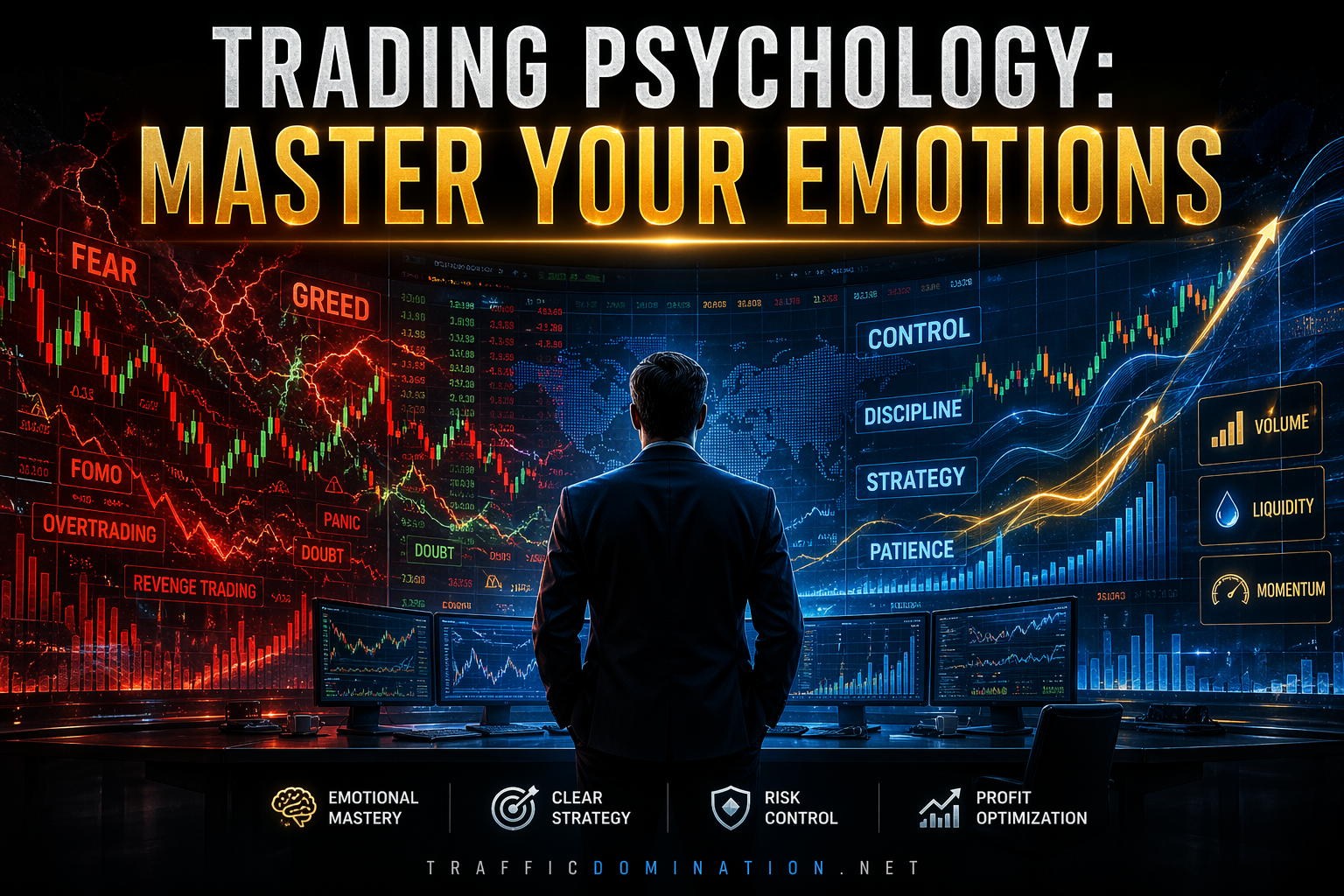
1. Introduction: Why Trading Psychology Controls Your Profits
Trading is often misunderstood as a purely technical activity—people assume that if they learn chart patterns, indicators, and entry strategies, success will automatically follow. In reality, the market is not just a system of signals; it is a constantly shifting environment driven by human behavior, emotion, and pressure. This is exactly where trading psychology becomes the real deciding factor between consistent profit and repeated loss.
Most traders enter the market with strong expectations but quickly realize that having a good strategy is not enough. The real challenge appears when money is on the line. In those moments, emotions take control. Fear causes early exits from winning trades. Greed pushes traders to overstay positions or increase risk unnecessarily. Uncertainty creates hesitation, leading to missed opportunities even when the setup is perfect. These emotional reactions often destroy otherwise solid trading plans.
This is why most traders fail—not because their strategy is completely wrong, but because they cannot execute it consistently under pressure. The market does not punish lack of knowledge as much as it punishes lack of emotional control.
At https://trafficdomination.net/, we view trading through a structured framework that connects market behavior with trader behavior:
- Traffic = Market Volume, Liquidity, Momentum
- Domination = Strategy, Control, Profit Optimization
This model highlights an important truth: the market itself is “traffic.” It represents movement, participation, and energy. Volume shows how many participants are active. Liquidity shows how easily positions can be entered or exited. Momentum shows how strongly price is moving in a direction. Together, these elements create opportunity—but only for traders who can control themselves.
The second part, Domination, is where real success happens. Strategy alone is not enough. Control is what allows a trader to follow that strategy without emotional interference. Profit optimization is the outcome of executing discipline consistently—cutting losses quickly, protecting capital, and maximizing winning trades without emotional distortion.
Without psychological control, even the strongest “traffic conditions” in the market—high volume breakouts, strong liquidity zones, and powerful momentum moves—can turn into losses. Instead of riding the opportunity, traders often panic, hesitate, or act impulsively. In contrast, a disciplined trader recognizes the same conditions as structured opportunities and executes with confidence and precision.
In simple terms, the market does not reward intelligence alone—it rewards emotional stability under pressure. Trading psychology is what transforms raw market traffic into controlled domination and long-term profitability.
2. Understanding Trading Psychology (The Hidden Market Engine)
Trading psychology is often described as the “hidden engine” of trading because it operates quietly in the background, yet it has complete control over every action a trader takes. While charts, indicators, and strategies are visible and measurable, trading psychology is invisible—but it determines how effectively all of them are used in real-time market conditions.
At its core, trading psychology is the mental and emotional state that influences every trading decision. It is the internal dialogue, emotional reaction, and subconscious bias that shape how a trader responds to price movement. Even when two traders are using the same strategy, their psychological state can produce completely different results. One may execute with discipline, while the other hesitates, overtrades, or exits too early.
Trading is not a mechanical process—it is a decision-making environment under uncertainty. This means every action is influenced by emotional pressure. Whether the market is moving fast or slow, trading psychology determines how a trader interprets that movement and what action they take next.
Trading psychology directly controls four critical pillars of trading performance:
1. Entry Timing
Entry timing is not just about recognizing a setup; it is about the confidence to execute it without hesitation. Fear often causes traders to delay entries, missing optimal positions. On the other hand, greed can push traders to enter too early without confirmation. A stable psychological state allows precise and confident execution when market conditions align with strategy.
2. Exit Discipline
Exiting a trade is often more emotionally difficult than entering one. Many traders struggle to close winning trades due to greed, hoping for more profit, or refuse to close losing trades due to denial. Strong trading psychology enforces discipline, ensuring exits are based on plan—not emotion.
3. Risk Management
Risk management is the backbone of long-term survival in trading. However, emotional pressure often leads traders to increase risk after losses or ignore stop-losses altogether. Trading Psychology determines whether a trader respects their risk rules or breaks them under stress. Without emotional control, even the best risk system becomes ineffective.
4. Position Sizing
Position sizing is directly linked to emotional stability. Traders under psychological pressure often over-leverage during high confidence phases or reduce size too much after losses. Proper trading psychology ensures consistent, calculated position sizing aligned with strategy and account protection.
What makes trading psychology even more critical is its impact during active market conditions. In environments with high liquidity and strong momentum, decisions must be fast and precise. These are the exact moments when emotions are most intense. Price moves quickly, opportunities appear and disappear within seconds, and pressure increases significantly.
In such conditions, trading psychology becomes the deciding factor between success and failure. Two traders may see the same momentum breakout—one executes with discipline and captures profit, while the other hesitates, overthinks, or reacts emotionally and misses the move entirely.
This is why trading psychology is called the hidden market engine. It does not appear on the chart, but it drives every decision behind the chart. Without mastering it, even a strong understanding of market structure, volume, liquidity, and momentum cannot produce consistent results.
Ultimately, trading psychology determines not just what you see in the market—but how you behave inside it.
3. The Core Emotional Drivers: Fear vs Greed
In trading, every decision ultimately comes down to two powerful emotional forces: fear and greed. These are not just emotions—they are behavioral patterns that directly shape how a trader interacts with the market. No matter how advanced the strategy is, these two drivers often determine whether a trader executes properly or self-sabotages their own results.
At https://trafficdomination.net/, we understand the market as a flow of traffic (volume, liquidity, momentum), but fear and greed decide how effectively a trader can operate within that flow. Even in ideal market conditions, emotional imbalance can turn opportunity into loss.
Fear: The Exit of Opportunity
Fear in trading is often subtle at first, but its impact is extremely powerful. It does not always stop a trader from entering the market—it usually appears after entry, when price begins to move.
Fear typically causes:
- Early exit from winning trades
Traders close profitable positions too soon, worried that profits might disappear. This limits profit potential and breaks consistency. - Hesitation in high-volume setups
Even when market volume and liquidity confirm a strong opportunity, fear creates doubt. Traders hesitate, waiting for “extra confirmation” that often leads to missed entries. - Missing momentum opportunities
In fast-moving markets, fear slows decision-making. By the time action is taken, the momentum phase is already over.
Fear is essentially a protective mechanism—but in trading, overprotection leads to underperformance. It prevents traders from fully participating in high-quality market moves, especially during strong traffic conditions (volume spikes and momentum bursts).
Greed: The Expansion of Risk
While fear causes hesitation, greed causes overextension. It pushes traders to go beyond their plan, often in pursuit of more profit or faster results.
Greed typically leads to:
- Overtrading during high liquidity conditions
When the market is active and liquid, traders feel constant opportunity. Greed turns this into excessive trading, reducing quality and increasing risk exposure. - Holding losing trades too long
Instead of accepting a loss, greed convinces the trader that the market will reverse. This often leads to larger drawdowns. - Chasing price during momentum spikes
In strong momentum phases, traders enter late positions out of fear of missing out. This results in poor entry points and increased volatility risk.
Greed distorts rational decision-making. Instead of following strategy, traders start reacting emotionally to market movement, especially during high momentum and volatility environments.
The Balance Between Fear and Greed
Fear and greed are not completely removable—they are part of trading psychology. The goal is not elimination, but control and balance. A disciplined trader does not react emotionally to every price movement; instead, they follow a structured plan regardless of internal pressure.
When fear dominates, opportunities are missed. When greed dominates, capital is destroyed. In both cases, the trader loses alignment with the market’s real structure—traffic flow (volume, liquidity, momentum).
Foundation of Traffic Domination
Mastering fear and greed is the foundation of true market domination. Without emotional control, even the strongest strategy fails under pressure. With control, even simple strategies become powerful because execution remains consistent.
At its core, traffic domination in markets is not about predicting every move—it is about:
- Staying disciplined in high-volume environments
- Remaining calm during momentum spikes
- Executing strategy without emotional distortion
Once fear and greed are controlled, a trader moves from reactive behavior to structured execution—this is where real consistency and profitability begin.
4. Market Psychology vs Trading Strategy
In trading, many people focus heavily on building the “perfect strategy”—searching for the best indicators, the most accurate entry signals, or the most profitable setups. While strategy is important, it is only one half of the equation. The real performance of a trader is not determined by the strategy itself, but by the trading psychology behind its execution.
A strategy provides structure. It tells you what to do in the market. But trading psychology decides whether you actually do it when the moment arrives.
Strategy: “What to Trade”
A trading strategy is the technical framework that defines:
- Entry conditions (when to enter a trade)
- Exit conditions (when to take profit or cut loss)
- Risk parameters (how much to risk per trade)
- Market conditions (when to trade and when to stay out)
In simple terms, strategy is the rulebook. It is designed based on analysis, backtesting, and market logic. It identifies opportunities in market traffic conditions such as volume, liquidity, and momentum.
However, a strategy on paper is always perfect. It does not feel fear, hesitation, or pressure. That is why many traders assume having a strong strategy guarantees success—but in real trading environments, execution is never purely mechanical.
trading Psychology: “Whether You Actually Follow It”
Trading psychology is what happens in real time when money is at risk. It is the emotional response that determines whether a trader follows the plan or breaks it.
Even with a profitable strategy, trading psychology can interfere in several ways:
- Entering too early out of excitement or fear of missing out
- Skipping valid signals due to hesitation
- Exiting trades prematurely due to fear
- Ignoring stop-loss rules during emotional stress
- Overtrading after a winning or losing streak
This is where most trading problems begin—not in the strategy, but in the execution gap between logic and emotion.
trading Psychology transforms a written plan into real action. If trading psychology is unstable, even the most advanced strategy becomes inconsistent in real market conditions.
The Critical Difference
The relationship between strategy and trading psychology can be summarized very clearly:
- Strategy = “What to trade”
- Trading Psychology = “Whether you actually follow it”
This difference is what separates consistent traders from inconsistent ones. Many traders know exactly what to do, but they fail to execute it properly under pressure. Knowledge exists, but execution breaks down.
When Emotions Override Discipline
The market does not behave in a calm, predictable way. It constantly shifts between different phases of traffic—volume expansion, liquidity changes, and momentum spikes. These environments create pressure, urgency, and emotional triggers.
In such conditions, even a strong system can fail if trading psychology is not stable.
For example:
- During volume spikes, traders may rush entries without confirmation
- During news-driven momentum, fear or excitement leads to impulsive trades
- During liquidity shifts, traders may exit too early or hold positions incorrectly
These are moments where discipline is most tested. The strategy still provides clear rules, but emotions often interfere with execution.
Why Systems Fail Without Trading Psychology
A trading system is only as strong as the trader executing it. Without psychological control:
- Rules are ignored during stress
- Risk management becomes inconsistent
- Decision-making becomes reactive instead of structured
This creates a gap between “knowing” and “doing.” That gap is where losses occur.
Even the most profitable systems in the world fail when traders cannot maintain discipline during high-traffic market conditions—when volume increases, liquidity shifts rapidly, and momentum accelerates.
5. Emotional Cycles in Trading (The Profit Trap)
One of the most damaging yet least understood aspects of trading is the emotional cycle that traders repeatedly fall into. Unlike strategy errors, which are technical and fixable, emotional cycles are behavioral patterns that silently repeat until they are consciously controlled. These cycles are often the real reason traders lose consistency—even when they have a profitable system.
In trading, emotions do not stay static. They evolve based on wins, losses, and market pressure. This creates a repeating loop that can either build discipline or destroy an account, depending on how it is managed.
The Emotional Cycle Pattern
Most traders go through a predictable psychological sequence:
Confidence → Overconfidence → Loss → Fear → Revenge Trading → Breakdown
Each stage influences the next, creating a chain reaction that pulls traders away from their strategy and into emotional decision-making.
1. Confidence: The Starting Phase
Confidence begins after a few winning trades or a good streak. In this phase:
- The trader feels in control
- Strategy seems reliable
- Execution feels smooth
This is a healthy stage when balanced. Confidence is necessary for decision-making, but it must remain grounded in discipline.
However, this stage is also where the cycle begins to shift if not controlled.
2. Overconfidence: The Hidden Turning Point
Overconfidence develops when success starts to feel guaranteed.
At this stage:
- Traders begin to believe they “understand the market” fully
- Rules start to feel less important
- Risk is increased without proper calculation
- Trades are taken more frequently
This is the first dangerous deviation from structured trading. Overconfidence slowly disconnects the trader from their system and from market reality (volume, liquidity, momentum behavior).
3. Loss: The Reality Check
After overconfidence, losses inevitably occur. The market does not reward emotional expansion.
When losses hit:
- Confidence drops suddenly
- Doubt enters decision-making
- Strategy is questioned
This phase is critical because it determines whether the trader returns to discipline or falls deeper into emotional trading.
4. Fear: The Emotional Contraction
After experiencing losses, traders often shift into fear-based behavior:
- Hesitation before entering trades
- Missing valid setups
- Reducing position sizes excessively
- Avoiding high-quality opportunities in strong market conditions
Even when liquidity and momentum are favorable, fear prevents execution. The trader becomes reactive instead of strategic.
5. Revenge Trading: The Emotional Reaction
This is one of the most destructive phases in trading psychology.
Revenge trading happens when a trader tries to “recover” losses quickly by:
- Increasing trade size impulsively
- Entering low-quality setups
- Ignoring risk management rules
- Trading emotionally instead of logically
This behavior usually occurs during volatile high-traffic market conditions, where volume and momentum amplify mistakes rapidly.
Instead of recovering losses, traders often accelerate them.
6. Breakdown: Loss of Control
If revenge trading continues, it leads to complete emotional breakdown:
- Strategy is abandoned
- Discipline disappears
- Decisions become random
- Confidence is heavily damaged
At this stage, trading is no longer structured—it becomes emotional reaction to the market.
Why This Cycle Repeats
The emotional cycle continues because most traders focus only on strategy, not trading psychology. Without mental awareness, each stage naturally flows into the next.
Markets constantly expose traders to:
- Rapid volume changes
- Sudden liquidity shifts
- Strong momentum spikes
These conditions amplify emotional reactions, making it easier to fall into the cycle again and again.
Breaking the Profit Trap
The only way to break this cycle is through structured discipline and mental rules, such as:
- Following fixed risk per trade
- Sticking to a predefined trading plan
- Avoiding trading after consecutive losses
- Controlling position sizing regardless of emotion
- Maintaining a consistent execution routine
Discipline acts as a stabilizer that interrupts emotional escalation before it turns into destructive behavior.
6. The Concept of Market Traffic (Volume, Liquidity, Momentum)
At https://trafficdomination.net/, the market is not viewed as a random collection of candlesticks or isolated price movements. Instead, it is treated as a living system of “traffic”—a continuous flow of activity driven by participants, orders, and reactions. Understanding this “traffic” is essential because it directly shapes both opportunity and emotional pressure in trading.
Market behavior can be broken down into three core components:
1. Volume (Traffic Flow): How Much Participation Exists
Volume represents the level of participation in the market. It shows how many traders, institutions, and algorithms are actively buying and selling at any given moment.
Think of volume as the traffic flow on a highway:
- High volume = heavy traffic with strong participation
- Low volume = empty road with weak activity
In trading terms, volume matters because it confirms the strength behind price movement. A price move with high volume indicates strong interest and conviction, while low volume suggests weak or uncertain participation.
When volume increases:
- Breakouts become more reliable
- Trends gain strength
- Price movements accelerate
However, high volume also increases emotional pressure because everything happens faster, forcing traders to make quicker decisions.
2. Liquidity (Ease of Execution): How Smoothly Trades Execute
Liquidity represents how easily trades can be executed without causing large price changes. It reflects the depth and availability of buy and sell orders in the market.
Using the traffic analogy, liquidity is like:
- A wide, multi-lane highway (high liquidity)
- A narrow road with obstacles (low liquidity)
In high liquidity conditions:
- Orders are filled quickly and efficiently
- Slippage is minimal
- Large positions can be entered or exited smoothly
In low liquidity conditions:
- Price can move sharply with small orders
- Execution becomes unpredictable
- Volatility increases unexpectedly
Liquidity is critical because it determines how cleanly a trader can enter and exit positions. Without liquidity, even a correct analysis can result in poor execution.
3. Momentum (Directional Force): Speed and Strength of Movement
Momentum is the force behind price movement. It shows how quickly and strongly the market is moving in a particular direction.
Momentum is similar to the speed of traffic flow:
- Strong momentum = fast-moving highway traffic in one direction
- Weak momentum = slow, inconsistent movement
In trading, momentum is what creates opportunities for profit. It turns small moves into large trends and allows traders to capture significant price expansion.
When momentum is strong:
- Trends develop rapidly
- Breakouts extend further
- Price reacts faster to news or volume shifts
However, strong momentum also increases emotional pressure because decisions must be made quickly, often without hesitation.
The Interaction Between Volume, Liquidity, and Momentum
These three elements do not work independently—they interact constantly:
- High volume fuels stronger momentum
- High liquidity allows smoother execution of that momentum
- Momentum reveals the direction created by volume and liquidity imbalance
When all three align, the market enters a high-traffic environment where opportunities are abundant—but so is psychological pressure.
High Traffic Environments and Emotional Pressure
High traffic conditions occur when:
- Volume spikes suddenly
- Liquidity shifts rapidly
- Momentum accelerates strongly
These conditions are often triggered by:
- News events
- Institutional activity
- Market openings and sessions
- Breakouts and liquidity grabs
While these environments create the best trading opportunities, they also amplify emotional reactions.
Why? Because everything happens faster:
- Decisions must be made instantly
- Price moves unpredictably
- Fear of missing out increases
- Fear of loss becomes stronger
Even experienced traders feel pressure in these moments. Without psychological control, traders tend to:
- Enter too early or too late
- Overreact to short-term fluctuations
- Exit trades prematurely
- Overtrade due to excitement
Why Trading Psychology Becomes More Important in High Traffic Markets
In low activity markets, mistakes are slower and more forgiving. But in high traffic conditions, every emotional reaction is amplified.
This is why trading psychology becomes essential:
- It prevents impulsive decisions during volatility
- It maintains discipline when speed increases
- It ensures strategy is followed under pressure
At trafficdomination.net, the core idea is simple:
The market becomes more powerful when traffic increases—but only traders with strong psychological control can convert that traffic into structured domination (strategy, control, profit optimization) instead of emotional losses.
7. Domination Principle: Strategy + Control = Profit Optimization
At https://trafficdomination.net/, trading success is not defined by strategy alone, but by the integration of strategy with emotional control, leading to consistent profit optimization. This is what we call the Domination Principle—a structured approach where execution quality matters more than theoretical knowledge.
Many traders assume that having a good strategy is enough to win in the market. However, real trading conditions—driven by volume, liquidity, and momentum (market traffic)—constantly test discipline. Without control, even a profitable system collapses under emotional pressure.
The Domination Principle can be broken down into three essential components:
1. Strategy: Clear Entry/Exit Systems
Strategy is the foundation of trading. It defines exactly:
- When to enter a trade
- When to exit a trade
- Where to place stop-loss
- How to identify setups in different market conditions
A strong strategy is built on logic, structure, and historical behavior of the market. It is designed to take advantage of predictable patterns within market traffic conditions such as volume spikes, liquidity zones, and momentum trends.
However, strategy alone is only a blueprint. It does not guarantee execution. It tells you what should be done—but not whether you will actually follow it in real-time pressure situations.
2. Control: Emotional Discipline
Control is the most critical element in trading because it determines execution quality. It is the ability to follow the strategy without being influenced by fear, greed, hesitation, or excitement.
Emotional control includes:
- Sticking to entry rules without hesitation
- Accepting losses without emotional reaction
- Avoiding overtrading in high-volume environments
- Not chasing price during strong momentum moves
- Maintaining consistency regardless of previous outcomes
In volatile markets, especially during high liquidity shifts and momentum spikes, emotions become stronger. Without control, traders start deviating from their system. This is where most losses occur—not because of bad strategy, but because of broken discipline.
Control ensures that decisions are based on logic, not emotional impulses.
3. Profit Optimization: Scaling Winners and Cutting Losses Fast
Profit optimization is the outcome of combining strategy and control effectively. It is not just about winning trades—it is about maximizing profitability over time.
This includes:
- Letting winning trades run according to plan
- Cutting losing trades quickly without hesitation
- Managing risk consistently across all trades
- Scaling positions only when conditions are favorable
- Avoiding emotional decision-making after gains or losses
Profit optimization is what turns a good strategy into a sustainable trading system. It ensures that losses are controlled and winners are fully captured during strong market movements.
In terms of market traffic, profit optimization allows traders to:
- Capture full momentum moves during high-volume conditions
- Avoid unnecessary losses during liquidity traps
- Maximize efficiency in fast-moving environments
Why Strategy Alone Fails Without Control
One of the most common reasons traders fail is assuming that strategy is the most important factor. In reality, strategy only works when execution is disciplined.
Without control:
- Traders enter trades impulsively
- Stop-loss rules are ignored
- Profits are cut too early
- Losses are held too long
- Overtrading becomes common
In volatile market conditions—especially when volume increases, liquidity shifts, and momentum accelerates—these mistakes become even more damaging.
A strategy without control is like a map without a driver. It has direction, but no execution.
The Core Idea of Domination
The Domination Principle is not about predicting the market—it is about executing consistently within it.
True domination happens when:
- Strategy defines structure
- Control ensures discipline
- Profit optimization creates long-term growth
When these three elements work together, trading becomes systematic instead of emotional.
8. Common Psychological Mistakes Traders Make
In trading, most losses are not caused by lack of strategy—they are caused by psychological mistakes made under pressure. Even when traders understand the market structure, they often fail to execute correctly because emotions override logic. These errors become even more dangerous in high-traffic market conditions (volume spikes, liquidity shifts, momentum bursts) where decisions must be fast and disciplined.
Below are the most common psychological mistakes that consistently destroy trading performance and break profit optimization systems.
1. Revenge Trading After Losses
Revenge trading happens when a trader tries to recover losses immediately after a losing trade. Instead of following the strategy, the trader becomes emotionally reactive.
This leads to:
- Increasing position size without analysis
- Entering low-quality setups
- Trading outside the plan
- Ignoring market conditions
After a loss, emotions like frustration and anger take control. The trader stops thinking logically and starts “fighting the market.”
In most cases, revenge trading turns a small loss into a much larger drawdown because decisions are no longer based on strategy, but emotional recovery pressure.
2. Overtrading in High-Volume Markets
High-volume environments create the illusion of constant opportunity. When market traffic increases (volume, liquidity, momentum), traders often feel they must be active all the time.
This leads to:
- Taking unnecessary trades
- Entering without strong confirmation
- Reducing trade quality
- Exhausting mental focus
Instead of waiting for high-probability setups, traders force trades because the market looks “active.” Overtrading reduces consistency and increases exposure to random noise in the market.
3. Ignoring Stop-Losses
One of the most destructive psychological mistakes is refusing to accept a loss. Stop-losses are designed to protect capital, but emotions often override them.
Traders ignore stop-losses because of:
- Hope that the market will reverse
- Fear of accepting failure
- Desire to avoid realizing a loss
This behavior turns controlled risk into uncontrolled damage. In volatile momentum-driven markets, ignoring stop-losses can quickly escalate small losses into major account drawdowns.
4. Moving Targets Due to Greed
Greed causes traders to change their original plan while a trade is already active.
Common behaviors include:
- Moving take-profit levels higher and higher
- Removing stop-losses too early
- Holding trades far beyond planned targets
- Expecting “just a little more profit”
This destroys structured execution. Instead of following a predefined system, traders start reacting emotionally to price movement.
Greed distorts discipline and breaks the core principle of profit optimization, which depends on consistency—not wishful thinking.
5. Entering Trades Based on FOMO (Fear of Missing Out)
FOMO is one of the most powerful emotional triggers in trading. It occurs when traders see fast-moving price action and feel pressured to enter late.
This leads to:
- Entering after the move has already started
- Buying at highs or selling at lows
- Ignoring proper entry conditions
- Chasing momentum blindly
In high-momentum and high-liquidity conditions, FOMO becomes even stronger because price moves quickly and opportunities appear limited. However, FOMO entries usually have poor risk-to-reward ratios and high failure rates.
How These Mistakes Destroy Profit Optimization Systems
A profit optimization system depends on three key pillars:
- Consistent strategy execution
- Controlled risk management
- Emotional discipline
Psychological mistakes break all three:
- Revenge trading destroys risk control
- Overtrading reduces trade quality
- Ignoring stop-losses breaks capital protection
- Greed distorts exit discipline
- FOMO leads to low-quality entries
When these behaviors take over, even a profitable strategy becomes inconsistent and unreliable.
9. How to Master Trading Emotions (Practical Framework)
Mastering trading emotions is not about eliminating feelings—it is about building a structured system that prevents emotions from controlling decisions. In real markets, especially during fast-moving volume, liquidity, and momentum (market traffic) conditions, emotional reactions happen naturally. The key is not to avoid them, but to neutralize their impact through discipline and structure.
At https://trafficdomination.net/, emotional control is treated as a practical skill built through rules, repetition, and consistency—not motivation or theory. Below is a clear framework to develop real psychological stability in trading.
1. Follow a Strict Trading Plan
A trading plan is your operational rulebook. It removes guesswork and replaces it with structure.
A strong trading plan includes:
- Entry conditions (exact setup requirements)
- Exit rules (profit targets and stop-loss levels)
- Market conditions to trade and avoid
- Maximum number of trades per session
- Risk per trade and overall exposure limits
When a trader follows a strict plan, decisions are no longer emotional—they are procedural. This reduces impulsive actions during high momentum or volatile market conditions, where emotional pressure is strongest.
Without a plan, every market movement feels like an opportunity or threat. With a plan, the market becomes structured and predictable in behavior.
2. Use Risk Limits Per Trade
Risk management is the backbone of emotional control. When risk is predefined, emotional pressure automatically decreases.
Key principles include:
- Risking only a fixed percentage per trade
- Never increasing risk based on emotions (revenge or excitement)
- Accepting losses as part of the system, not failure
- Keeping risk consistent across all market conditions
When traders know the maximum they can lose per trade, fear is reduced and decision-making becomes clearer. In high-liquidity and high-volume environments, this prevents emotional overreaction to fast price movements.
Risk limits act as a psychological shield that protects both capital and mental stability.
3. Keep a Trading Journal
A trading journal is one of the most powerful tools for emotional mastery. It turns trading from guesswork into measurable performance analysis.
A proper journal records:
- Entry and exit reasons
- Emotional state during the trade
- Whether the plan was followed or broken
- Outcome and lessons learned
Over time, the journal reveals patterns:
- When emotions interfere most
- Which mistakes repeat
- How discipline affects profitability
This awareness is critical. Traders cannot fix what they do not observe. A journal creates self-accountability, which is essential for long-term profit optimization and consistency.
4. Take Breaks After Losses
One of the most important but ignored rules in trading psychology is stepping away after a loss.
After a losing trade:
- Emotions are heightened
- Decision-making becomes reactive
- Risk of revenge trading increases
Taking a break allows the mind to reset before re-entering the market. This can be:
- A short pause after each loss
- Ending the trading session after consecutive losses
- Avoiding immediate re-entry into volatile conditions
In fast momentum-driven markets, continuing to trade emotionally often leads to compounding losses. Breaks restore clarity and prevent emotional escalation.
5. Focus on Process, Not Profit
One of the biggest psychological shifts in trading is moving from outcome-focused thinking to process-focused execution.
Instead of asking:
- “How much did I make today?”
Focus on:
- “Did I follow my plan correctly?”
- “Did I manage risk properly?”
- “Did I execute without emotion?”
Profits are the result of correct process execution over time. When traders focus only on money, emotions like greed and fear intensify. When they focus on process, decisions become more stable and systematic.
This mindset shift is essential during unpredictable market traffic conditions, where outcomes can vary even with correct execution.
Why This Framework Works
This practical system works because it removes emotional decision-making and replaces it with structure:
- Trading plan = removes uncertainty
- Risk limits = reduce fear and overconfidence
- Journal = builds self-awareness
- Breaks = prevent emotional escalation
- Process focus = eliminates greed-driven behavior
Together, these elements create a controlled environment where emotions exist but do not dominate decisions.
10. Final Conclusion: Master Yourself, Then Master the Market
True trading success is often misunderstood. Many traders spend years trying to improve predictions—searching for better indicators, more accurate signals, or “perfect” entry timing. But the market does not reward prediction alone. It rewards execution under pressure. And execution is not a technical skill—it is a psychological one.
At its core, trading is not about controlling the market. The market will always remain uncertain, fast, and influenced by countless participants. Instead, real success comes from controlling the only thing a trader can truly control: themselves inside the market.
Trading is Internal, Not External
Most failures in trading do not come from incorrect analysis, but from emotional reactions:
- Entering too early out of excitement
- Exiting too soon due to fear
- Holding losing trades due to hope
- Overtrading after emotional highs or lows
These behaviors happen not because the market is unpredictable, but because the trader becomes unpredictable under pressure.
This is why self-mastery is the foundation of consistent trading performance. Without emotional control, even accurate analysis becomes useless in real-time execution.
The Framework of Market Understanding
At https://trafficdomination.net/, we define the market through a structured lens:
- Market Traffic = Volume, Liquidity, Momentum
- Domination = Strategy, Control, Profit Optimization
This framework explains both sides of trading reality:
Market Traffic (External Environment)
The market is constantly moving through different conditions:
- Volume represents participation and activity
- Liquidity determines execution efficiency
- Momentum defines speed and direction
This “traffic” creates opportunity—but also pressure. It moves fast, shifts suddenly, and often triggers emotional reactions in traders who are unprepared.
Domination (Internal Mastery)
Domination is how a trader responds to that traffic:
- Strategy gives structure and direction
- Control ensures emotional discipline during execution
- Profit Optimization converts opportunities into consistent results
Without domination, market traffic becomes chaos. With domination, it becomes opportunity.
The Real Transformation in Trading
When these two elements are combined properly, a trader undergoes a fundamental shift:
From:
- Emotional reactions
- Impulsive decisions
- Inconsistent results
- Fear and greed-driven behavior
To:
- Structured execution
- Rule-based decision-making
- Consistent performance
- Controlled psychological state
This transformation is what separates amateurs from professionals.
Why Most Traders Stay Stuck
Many traders fail not because they lack knowledge, but because they never move beyond emotional trading. They understand strategies but cannot apply them consistently under pressure.
In real market conditions—especially during high traffic environments (volume spikes, liquidity shifts, momentum bursts)—emotions intensify. Without discipline, traders fall back into reactive behavior instead of structured execution.
This is where most accounts fail: not in strategy design, but in execution breakdown.
The Core Truth of Trading Mastery
The ultimate truth in trading is simple:
You do not master the market—you master your behavior within it.
The market will always fluctuate. It will expand and contract, accelerate and slow down, become predictable and unpredictable. But your reaction to it determines everything.
Final Insight
When you combine:
- Market Traffic (Volume, Liquidity, Momentum)
with - Domination (Strategy, Control, Profit Optimization)
you stop reacting emotionally and start operating systematically.
This is the transition point where trading changes from uncertainty-driven behavior into professional execution and long-term profitability.
At this level, trading is no longer about chasing opportunities—it becomes about executing structure within market chaos.
And that is the real meaning of mastery:
not controlling the market, but controlling yourself inside it.